
Stunning feather discovered in fossilised dinosaur poo is first of its kindBy science reporter Jacinta Bowler
Posted Fri 11 Sep 2026 at 1:00amFri 11 Sep 2026 at 1:00amFri 11 Sep 2026 at 1:00am
In short:
Palaeontologists have discovered an extremely well-preserved feather from an extinct bird in fossilised dinosaur faeces.
The researchers said the fossil could help explain why ancestors of modern birds survived the mass extinction 66 million years ago.
What’s next?
The researchers said the discovery was a “call to action” for scientists to scan other fossilised faeces to look for feathers.
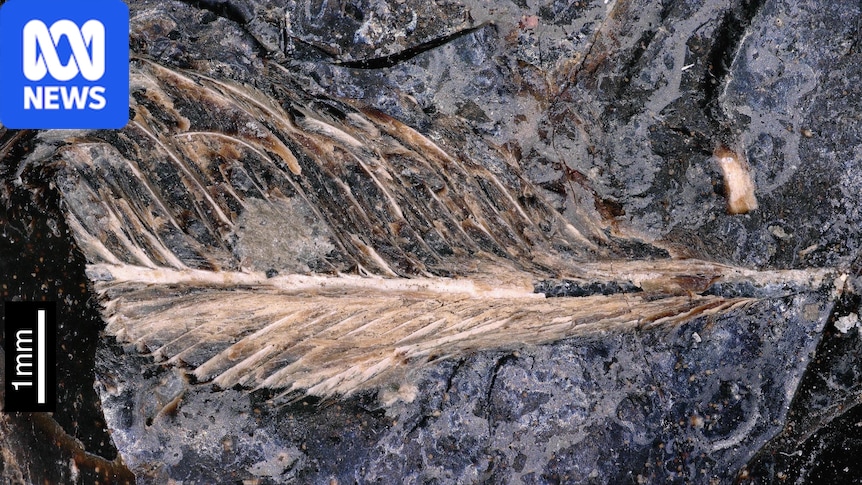
A piece of fossilised dinosaur poo contains one of the best-preserved feathers from the dinosaur age.
A palaeontologist found the feather by chance while looking for fish fossils.
Researchers said the discovery, published today in Current Biology, might provide clues about why today’s birds are the only dinosaur group that survived mass extinction.
Lead author Jingmai O’Connor, associate curator of fossil reptiles at the Field Museum in Chicago, said there might be more hidden feathers inside fossilised faeces, known as coprolites.
“This is the first-ever feather in a coprolite … and it probably would not have been found if it wasn’t for a lucky break,” Dr O’Connor said.
“This means that coprolites are potentially a new window through which we can study fossilised soft tissues.“
A lucky break
Coprolites are rare in the archaeological record because they are much more likely to decay compared to skeletons and teeth.
Study co-author David DeMar found the fossil in 2016 at the Hell Creek Formation in Montana.
The site is well known for dinosaur and fish fossils, but no feathers have been found there before.
“I was crawling up a rocky outcrop collecting fish fossils when I came across a dark, reddish-brown nodule about half the size of a golf ball,” Dr DeMar said.
“I picked it up and scanned its surface through my hand lens, and that’s when I couldn’t believe what I was seeing, a tiny fossil feather.“
It is unknown which dinosaur made the coprolite, but the researchers thought it could have been a Tyrannosaurus rex or Nanotyrannus based on the size and contents.
At some point, the fossilised faeces broke open, exposing a beautifully preserved feather from 66 million years ago — about the time most dinosaurs were wiped out.
“This is really exciting because this is from a place like Hell Creek, which is one of, if not the most, studied Late Cretaceous terrestrial fossil-bearing geologic unit,” Dr O’Connor said.
“People have been going there for 110-plus years, many teams from many museums.”
Micro-CT scanning revealed the coprolite contained multiple feathers, tiny fish scales and leg bones from a small bird.
Dr O’Connor said the four dinosaur species that could have made the coprolite were unlikely to have eaten fish.
“We hypothesise that those tiny fish scales were in the stomach of the bird when the bird was consumed,” she said.
“So this coprolite actually records two different food web interactions.”
Stunning feather from extinct bird
Steven Salisbury, a vertebrate palaeontologist at the University of Queensland, said the fossil was impressive.
“There are quite a few fossils that show feathers, but most of the time you’re just looking at impressions of feathers … the actual feather is not there,” Dr Salisbury said.
“This is cool because it’s actually the preserved feather in 3D.“
The feather is thought to belong to a hesperornithiform, a type of aquatic, flightless bird that did not survive the mass dinosaur extinction 66 million years ago.
Most bird groups, except for the earliest members of the birds alive today, were also wiped out at this time.
“Hesperornithiformes are most closely related to modern birds, the crown bird group,” Dr O’Connor said.
“[But] we can see that hesperornithiformes don’t have the full suite of modern plumage characteristics.”
According to Dr O’Connor, plumage might have been the difference between life and death during the extinction event.
“We can hypothesise that only crown birds had the full suite of … body feathers that are good for insulation, plus modern wing feathers.”
Dr Salisbury said this line of thought was “intriguing”.
“One of the great mysteries of any extinction event, and in particular the Cretaceous extinction event, is why some groups of animals get through, and others don’t,” he said.
“I don’t think we know exactly what happened.“
He said more fossils were needed to test the team’s hypothesis.
Dr O’Connor said there were likely more coprolite fossils containing feathers, and hoped other researchers and museums would CT scan their fossil faeces to check for feathers.
“It’s a bit of a call to action,” she said.