
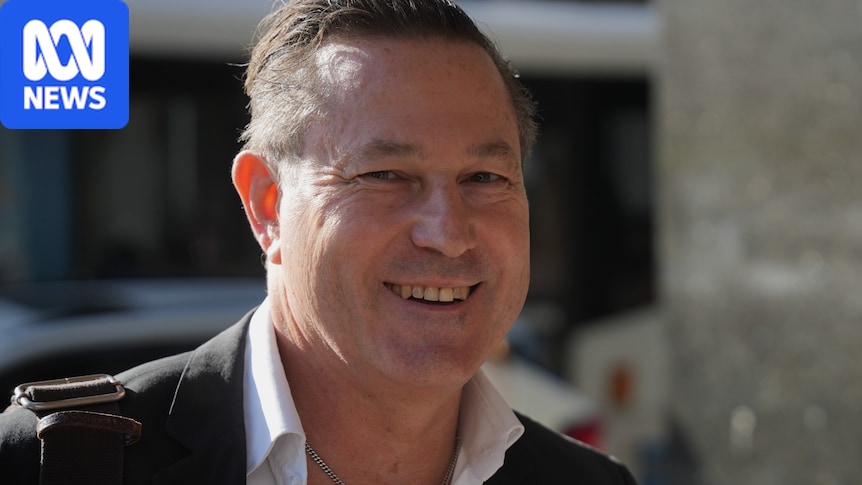
Sydney businessman Alexander Csergo sentenced to time behind bars for reckless foreign interference
Posted Thu 10 Sep 2026 at 3:12pmThu 10 Sep 2026 at 3:12pmThu 10 Sep 2026 at 3:12pm
In short:
Alexander Csgero will be eligible for parole as early as next month after being sentenced to three-and-a-half years behind bars for reckless foreign interference.
He is the first Australian to be sentenced for the offence, which relates to reports the Sydney businessman compiled for two suspected Chinese spies while he was working in Shanghai.
The district court judge judge took into account that Csergo had spent more than 600 days in custody prior to being sentenced.
Sydney businessman Alexander Csergo has been sentenced to three-and-a-half years in prison for reckless foreign interference, but will be eligible for parole as early as next month due to the time he has already spent in custody.
The long-running case about reports Csergo compiled for two suspected Chinese spies while he was working in Shanghai represents the first time an Australian has been sentenced for the charge.
A District Court jury found the 58-year-old guilty in March, after hearing weeks of evidence about Csergo’s communication and meetings with two people he knew as “Ken” and “Evelyn” between 2021 and 2023, when he returned to Sydney.
Csergo prepared reports, upon request and in return for payment, about topics including lithium mining, the change in the German government, defence, the Quad alliance and AUKUS.
The prosecution told jurors he believed they worked for a Chinese intelligence agency, the Ministry of State Security (MSS), and was reckless as to whether his conduct would support foreign intelligence activities.
But Csergo’s lawyers argued he handed over worthless information from open-source material along with fictitious interviews, and there was no evidence he ever revealed any national security secrets.
Judge Craig Smith found that the offending effectively took place between May or June 2022 until December 2022.
He said Csergo’s subjective awareness of his situation shifted around May 2022, in the context of being asked to prepare a defence report that was “materially different” to his previous work.
In WeChat messages to Csergo, specific topics of interest were identified including “China spy”, “anything about China in ASIO”, and strategy, targets, tactics, methods and technology.
Csergo warned Ken that they needed to be “careful” and said “we don’t want to find ourselves being questioned by any governments”.
He also said that one of his contacts had “strongly warned” him against what Ken had requested.
‘Degree of sophistication’ in offending
The judge found beyond reasonable doubt that Csergo was relevantly reckless from May or June 2022 and part of his conduct was deceptive, satisfying all four elements of the charge.
He said there was “clearly a persistence in his conduct” as he “extensively researched, downloaded and prepared materials”, and that there was a level of deception to the conduct.
Judge Smith said he did not consider Csergo’s conduct to have been “overly sophisticated in the criminal sense”, but there was a “degree of sophistication”.
He handed Csergo a backdated sentence of three years and six months, with a non-parole period of one year and ten months.
“The substantial effect of the sentence … is you would be eligible for consideration for release to parole on 24 October 2026,” the judge told Csergo, who appeared on a video link in the Downing Centre.
He took into account that Csergo had spent more than 600 days in custody prior to sentence, including a period between when he was arrested and then granted bail, and when he was taken into custody shortly after the jury’s verdict.
The judge accepted Csergo had no criminal history and was a person of good character.
He said the evidence showed he was an intelligent, highly-motivated and loyal person with strong support from his mother, brother and friends.
It demonstrated that he was “otherwise a decent man” who had committed a serious offence, the judge found.
Attempted contact with ex-prime minister
The judge also found that the nature of Csergo’s time in custody was a “significant matter” and said the evidence showed he has suffered a particularly hard and isolating time in prison which exacerbated mental health issues.
He said existing mental health issues, including heightened anxiety during COVID lockdowns, created a “degree of vulnerability” in Csergo when he was initially contacted on LinkedIn by someone seeking part-time consultancy services.
The court heard that at one point, Csergo attempted to contact former prime minister Kevin Rudd through an online contact form, but never interviewed Dr Rudd.
When he returned to Australia, Csergo had with him a so-called “shopping list” of subjects Ken and Evelyn were interested in, which the crown had highlighted as being important to the prosecution case.
But the judge did not accept the businessman intended to act upon the list.
“There is no evidence he did anything in relation to the shopping list, although there is evidence of his continuing communication with Ken while he was in Australia.”