
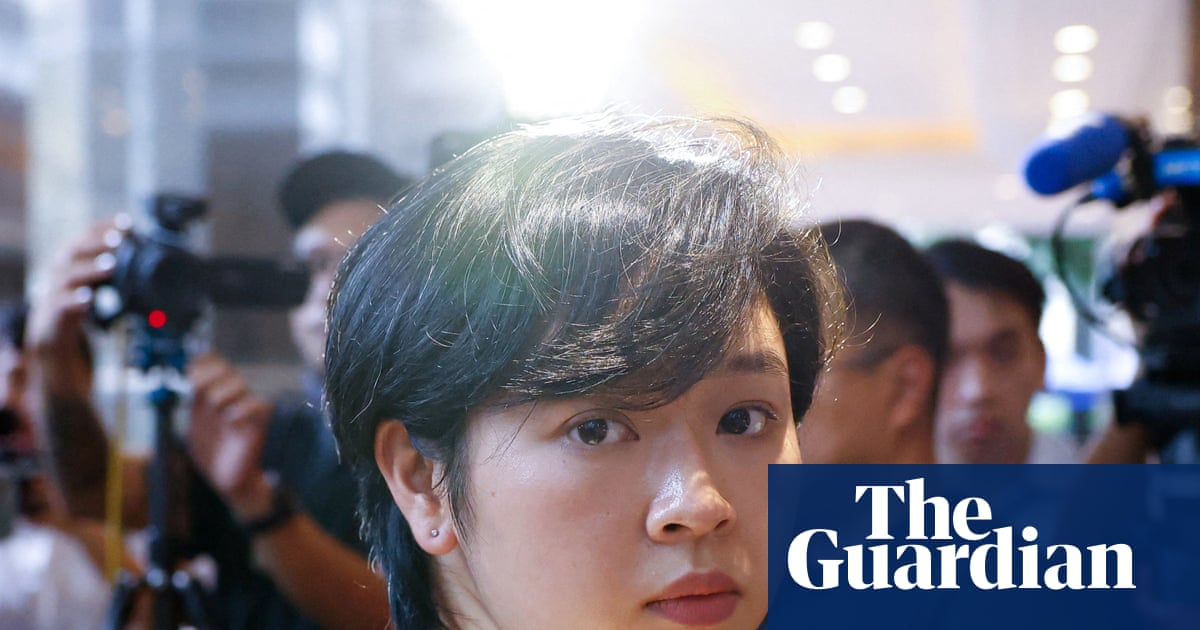
Wall Street Journal publisher convicted in Hong Kong of deterring reporter from union role
Dow Jones convicted of one count of deterring Selina Cheng from role at Hong Kong Journalist Association but cleared of second charge
A Hong Kong court has convicted the publisher of the Wall Street Journal of deterring a reporter from taking up a trade union role, in a case that raised concerns about press freedom in the city.
The newspaper dismissed Selina Cheng just weeks after she was appointed chair of the Hong Kong Journalist Association (HKJA) in 2024. She was told at the time her termination was officially due to restructuring.
Outside court on Thursday, Cheng said: “If reporters’ employment rights are not sufficiently safeguarded, or when their rights are violated and not enforced in law, then we can no longer work safely as reporters.”
Principal magistrate David Cheung ruled that Dow Jones Publishing, the parent company of the Wall Street journal, was guilty of “preventing or deterring an employee from exercising trade union rights,” but acquitted it of “dismissing or discriminating against an employee because she exercised those rights.”
Cheng, who covered China’s automobiles and energy sectors for the WSJ, said her editor had told her that employees should not be seen as advocating for press freedom in “places like Hong Kong”, saying it could be perceived as a conflict of interest. She alleged her employer had attempted to prevent her from taking up a role in the union.
She said the company told her that she needed to seek the firm’s approval for outside activities and requested her to leave her then-board position at the association.
Cheng launched the private prosecution against Dow Jones Publishing after losing her job in July 2024, weeks after taking up the position as chair of the union.
The company pleaded not guilty to both charges, which each carry a maximum fine of HK$100,000 (about $12,750).
Sentencing is expected to be handed down at a later date.
During the trial, the defence argued that Cheng was terminated because of redundancy and that the prosecution had not sufficiently proved that the firm’s management instructed Cheng’s supervisor. The defence also accused Cheng of acting in bad faith in a previous hearing.
But magistrate David Cheung said that Cheng’s termination “was motivated by wrongful and unjustified application of their code of conduct” when it insisted Cheng needed to seek prior approval to stand as chair of HKJA.
Cheung said he accepted Cheng’s explanation, describing the former WSJ reporter as “honest and reliable”, adding she and was clearly motivated by “the wish to see justice”.
Cheng’s termination alarmed journalists, who are already operating in an increasingly restricted media environment in the city, where foreign outlets have traditionally faced less pressure than local news outlets.
“The WSJ set a very bad precedent by punishing an employee who was exercising her constitutionally protected rights in Hong Kong,” said Eric Lai, a senior fellow at the Georgetown Center for Asian Law.
The WSJ maintained there was no link between Cheng’s role in the Hong Kong union and her termination. At the time of Cheng’s dismissal, it issued a statement saying: “The Wall Street Journal has been and continues to be a fierce and vocal advocate for press freedom in Hong Kong and around the world.”
HKJA is the oldest journalist union in Hong Kong. It was established in 1968 and is registered as a trade union representing journalists and workers in news. It has faced increasing pressure since the introduction of a Beijing-imposed national security law in 2020.
Hong Kong has fallen sharply in global press freedom rankings since the law’s introduction. In 2019 Reporters Without Borders ranked the city 73rd in the world. By 2026 it had fallen 67 places to 140th out of 180 countries and territories.
Explore more on these topics