
B.C. wine producers are bracing for the latest blow to cross-border alcohol sales, with the United States set to ban most Canadian alcohol imports later this month.
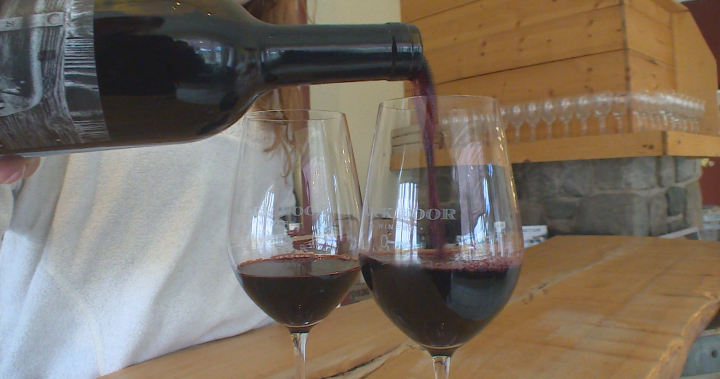
At Lightning Rock Winery in Summerland, the impact is expected to be significant.
“It seems that wine and booze in general in Canada and the U.S. is the punching bag for everything,” said Ron Kubek, owner of Lightning Rock Winery. “If I had known this, I wouldn’t have gone into the business.”
Kubek is bracing for the looming U.S. ban and the potential loss of roughly 500 cases of his wine sold in the United States each year.
“That’s about $120,000 to $150,000 a year,” he said.
At Painted Rock Estate Winery in Penticton, the direct financial hit is expected to be less significant, but the winery says losing access to the U.S. market could still have an important impact.
Story continues below advertisement
“It’s really important in terms of brand building. It’s something that we use to be able to get in front of important reviewers, in front of important influencers, and competitions,” said Lauren Skinner-Buksevics, the winery’s managing director.
B.C. wine producers were first hit with a 50 per cent tariff.
Get daily National news
Get daily Canada news delivered to your inbox so you’ll never miss the day’s top stories.
By providing your email address, you have read and agree to Global News’ Terms and Conditions and Privacy Policy.
Now, the U.S. is going a step further by moving to ban most Canadian alcohol imports entirely.
Jeff Guignard, president and CEO of the Wine Growers of British Columbia, says the consequences will be felt on both sides of the border.
“It’s going to hurt businesses on both sides of the border,” Guignard said. “When this ban comes in, it’s going to be Canadian producers, American importers, distributors, retailers, hospitality businesses who are going to be hurt by this.”
5:22
Okanagan Wineries Impacted by Wildfires
But Guignard says the broader implications of what he describes as a form of prohibition could be even more significant.
Story continues below advertisement
“I think it’s a really dangerous precedent that’s being set right here. It is showing us that the United States is a completely unreliable trading partner,” he said.
- Stranded in Winnipeg during cross-country drive to find work
- Enbridge makes US$2.55B acquisition of pipeline, storage systems in U.S. midwest
- How much will Trump’s ban on alcohol, dairy hurt Canada?
- Jamieson Greer blames Canada for U.S. hitting back over counter-tariffs
-
Ottawa invests nearly $900 thousand in Calgary start up to benefit indoor agriculture sector
-
Canadian businesses caught in middle of Trump’s intensifying trade war
-
Canadian counter-tariffs on U.S. goods take effect
-
Still no details from Metro Vancouver on Jerry Dobrovolny severance
The latest development is prompting renewed calls for Canada to eliminate interprovincial trade barriers that make it difficult for Canadian wineries to sell across the country.
“This is the time to solve interprovincial trade barriers and this is the time to allow Canadian businesses to build their brand here at home,” Skinner-Buksevics said.
Kubek agrees, saying governments need to do more to support Canadian-made wine, including prioritizing domestic products in government-run liquor stores.
“The B.C. LDB (B.C. Liquor Distribution Branch) is promoting a South African winery, ‘win a car.’ They’re promoting an Italian winery, wine region, ‘win a trip in France.’ You know, the Penticton liquor store, the Penticton B.C. liquor store has 12 rows devoted to foreign wines and only two to B.C.,” Kubek said.
“We need to look in the mirror and fix our own problems first. Then we can deal with the U.S.,” he added.
The ban is set to take effect on Sept. 29.
4:36
Direct-to-consumer alcohol sales expand in Canada