
Gold Coast charity helping at-risk youth build tiny homes
Posted Thu 10 Sep 2026 at 10:04amThu 10 Sep 2026 at 10:04amThu 10 Sep 2026 at 10:04am
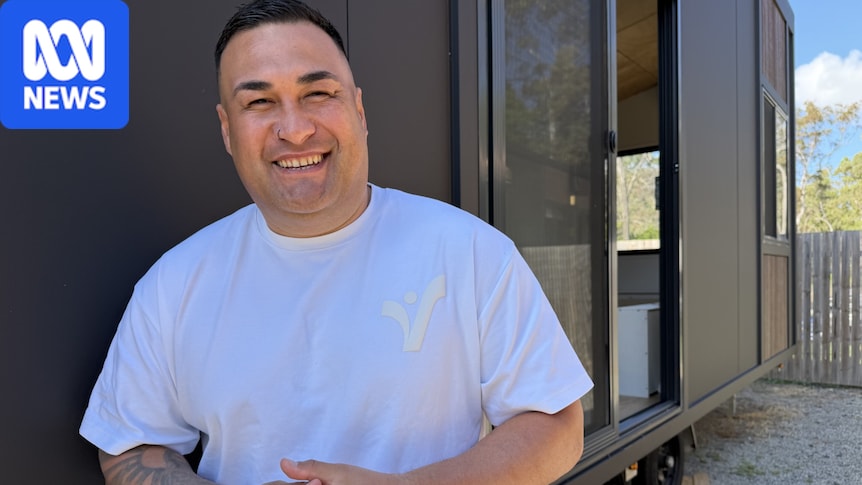
A Gold Coast charity is helping young people at risk of entering the juvenile justice system rebuild their future, one tiny home at a time.
The initiative, run by Everything Suarve (Esuarve), is helping vulnerable young people learn construction skills and create homes for people in need.
Esuarve works with people aged 16 to 24 who are disengaged from education and employment or are at risk of entering, or returning to, the youth justice system.
“Esuarve is often the last place before going to juvie or sometimes the first place as they’re released,”
founder Joseph Te Puni-Fromont said.
“We do work with what others may say is the too hard basket.”
Mr Te Puni-Fromont said he wanted to create a program where participants could give back to the community while gaining practical skills, so they partnered with a local tiny home company in 2023.
“[We] wanted to kill two birds with one stone — one, be able to reduce youth crime and two, be able to create another solution for the housing problem,”
he said.
Participants complete a 10-week program that leads to a Certificate I in Construction.
Before picking up a hammer, they spend the first two weeks focusing on mental wellbeing and behavioural change.
“Without looking after that, we believe it’s a waste of time giving them qualifications and getting them into a job because they only fall back into old habits and patterns that they’ve known their whole life,” Mr Te Puni-Fromont said.
The remaining eight weeks are spent building fully functional tiny homes.
“The homes arrive waterproofed, so the walls are already standing,” he said.
“We put all the external cladding on to finish the outside of the house, then everything inside is flat-packed.
‘We lay the flooring, install the cabinetry, kitchens, beds, showers and toilets, so they’re seeing almost the entire construction process from the ground up.”
To date, 14 tiny homes have been built through the initiative.
Eight are now housing people recovering from eating disorders at Queensland’s first recovery village on the Sunshine Coast.
Mr Te Puni-Fromont said the homes were only part of the success story.
“We’re dramatically changing these young people’s lives around and just providing them with the tools where they can be ready in life,”
he said.
“So 90 per cent of our kids have ended up in employment, and we’ve had 360 young people now come through our doors so it certainly works.
“And the scary thing is, we’re just warming up.”
Results backed by research
An Australian-first systematic review found strong evidence that vocational training programs in the construction industry can help reduce youth recidivism while helping address critical skills shortages across Australia’s building sector.
Bond University criminologist Terry Goldsworthy, who co-authored the review, said the literature confirmed that stable employment reduced reoffending, but many young offenders often lacked the knowledge, skills and experience needed to secure work.
“One of the things you can do is give them some kind of vocational training so that when they come out, they have the skill set that will enable them to get gainful employment and therefore hopefully avoid the need to reoffend,”
Dr Goldsworthy said.
Dr Goldsworthy said while youth offending in Queensland had declined over the past two years, reducing reoffending remained a key priority.
“We’ve had substantial problems with youth offending in recent years,” he said.
“Although those numbers are decreasing, we would still want to get them down to much lower levels, and this is one way you could achieve that.“
Detaining one young person costs the Queensland Government about $738,000 each year, according to the Productivity Commission.
Community-based rehabilitation programs that provide education, employment pathways and life skills can support the same young people at a fraction of the cost.
Esuarve now hopes to partner with the state government to build tiny homes for social and emergency housing.
“We had an opportunity to put in a tender for 50 homes a couple of years ago, but we weren’t ready,” Mr Te Puni-Fromont said.
“The reality is we’re ready now to fulfil some massive orders and we have the unique ability to be able to give young people a chance while doing it.“
Queensland Housing Minister Sam O’Connor said QBuild conducts an open procurement process and that Esuarve was welcome to apply for future tenders.
“We welcome organisations that are creating opportunities for vulnerable Queenslanders, including programs that help young people build skills, gain employment and turn their lives around,” Mr O’Connor said.