
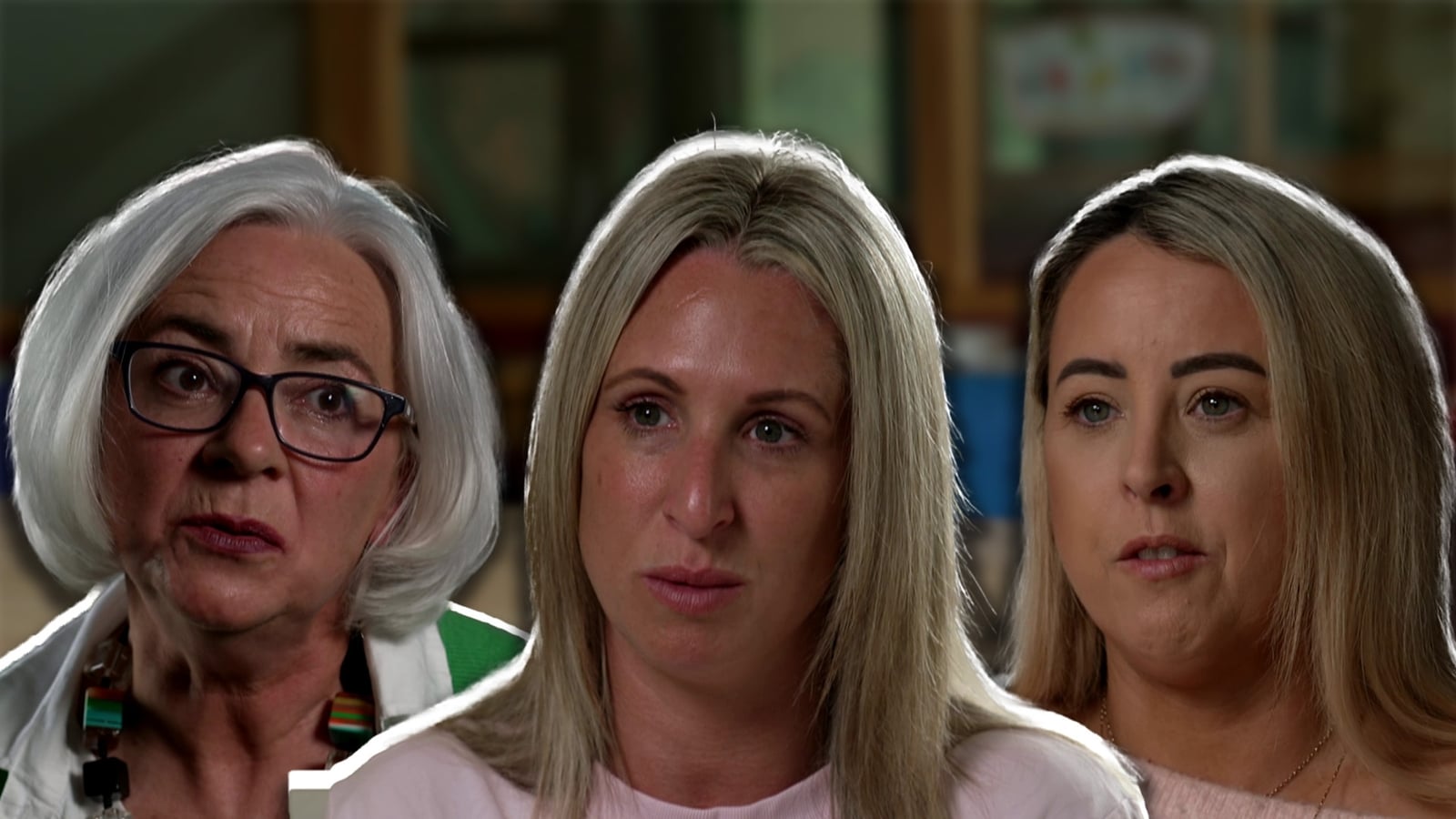
Parents of children at some Community Special Schools have criticised gaps in staffing and resources which they say have resulted in children with special educational needs regressing or being hurt at school.
In response to the increased demand for places, the Government has been expanding the Community Special School (CSS) model, with the schools run by local Education and Training Boards (ETBs) and catering for children with intellectual disabilities and complex needs.
There are currently 15 CSSs around the country – the first opened in 2019 – with three more due to open this school year.
However, parents who spoke to Prime Time say the specialist staffing and supports required by their children have not kept pace with the creation of new school places.
Louise O’Keeffe says her 13-year-old daughter Ella, who has an intellectual disability and autism, lost “hours and hours of progression” after she began attending Belmayne Community Special School in Dublin 13 last year.
The school was due to open in August 2025, but it did not begin operating until November. It then opened on reduced hours before gradually increasing to three and a half hours, while some students attended for even less time.
“It was a struggle for Ella. She really thrives on the routine of school and the short days were really kind of distressing for her,” Louise said.
“She was on two hours a day for a while, and it wasn’t until after Easter, the time went up to about three and a half hours a day” she added.
Louise says Ella also did not receive the one-to-one Special Needs Assistant (SNA) support she had been assessed as needing and had received in primary school.
Dublin Dun Laoghaire Education and Training Board (DDLETB) acknowledged in a statement to Prime Time, that the Belmayne school was set up on a “shortened time-frame” and it took a “a phased transition approach” to building up the staffing at the school.
It also said that “a number of operational challenges arose, including challenges in relation to staff recruitment.”
Louise says those staffing difficulties had consequences for children attending the school.
Daily feedback reports sent to Louise and seen by Prime Time record a number of incidents in which Ella was hurt by other pupils displaying challenging behaviour.
Ella also suffers from a medical condition, called neurofibromatosis, resulting in tumours beneath the skin and on the brain, which makes her physically vulnerable.
One report describes how another pupil “kicked her” before tripping himself “causing him to fall on top of her head.”
Another report describes three hair pulling incidents in one day.
Louise, who says she has nothing but praise for the school’s teachers and SNAs, believes they need greater therapeutic support to meet the complex needs of pupils.
“It’s actually quite upsetting to hear that your child is getting hurt in school. It’s not what to expect from a school for people with autism and complex needs,” says Louise.
Last year, Louise wrote to the NCSE about the reduced teaching hours and lack of supports. The NCSE responded saying that they had been informed that the school was providing a full school day.
In an email they advised her to “write directly to the principal to state that the NCSE and Patron are under the impression that the school is operating on a full school day”.
According to Louise, it was only after that principal left that a review of staffing was carried out and more SNAs and other supports were put into the school.
“It shouldn’t have had to be something so big for us to have to come together and for the school then to say, okay, well we put this in place, we put that in place,” Louise said.
This year, the school which caters for children from the ages of four to eighteen, opens from 9.30am-2.50pm, per day for most children.
The DDLETB says they now have more staff than children with 33 staff for 30 children.
However, Dr Laura Gormley, Assistant Professor at the School of Inclusion & Special Education at Dublin City University (DCU) said specialist schools should have the staffing and expertise required to support children in place from the outset, rather than building up those supports after opening.
“The model whereby schools are asked to just start and … work it out as they go on, that would not be best practice,” she said.
Yet concerns about staffing and specialist supports are not confined to newly established CSSs.
Parents at Carrigaline Community Special School in Co Cork, which opened five years ago, say they have faced similar difficulties.
Speaking in the Dáil last year, Taoiseach Micheál Martin described the Community Special School model as “the way forward” for special education, specifically citing Carrigaline Community Special School in his own constituency.
“The ETB is the way forward. I initiated the special schools under ETBs with the Minister, Deputy Foley, in recent years. Cork ETB is now the patron of Carrigaline Community Special School. That is the future and the State has to be proactive in providing special education places,” he said.
But parents of children at the Carrigaline school, setup in 2021, say their children are struggling to get the support they need to be educated.
“The Taoiseach was instrumental in opening the school. It’s in his constituency,” said Niamh O’Grady, whose 17-year-old son Artie attends the school.
“But once it opened, it was — the proper supports were not in place, the proper resources were not in place. We were sort of abandoned.”
“A huge proportion of the children in the school are non-verbal, so we’re their voices. We’ve had to fight that for five years” Niamh added.
It was only last year that the school received a speech and language therapist and an occupational therapist, each for 15 hours a week, for a school of 48 pupils.
Niamh says that lack of supports at the school has meant that her 17-year-old son Artie has regressed rather than improved his skills.
A recent letter from the Child and Adolescent Mental Health Service (CAMHS) about Artie refers to the negative impact the school situation is having on him.
It states: “All Art’s issues stem from his difficulties in school leading to overspill into other areas of his life. It is unfortunate that the school placement has had such a negative effect on Art leading to extremely challenging behaviours.”
The school has had ongoing issues with children’s dysregulation at the school.
Last March, the school was closed for six days after a staff member was injured due to a child’s challenging behaviour.
The school has also recorded 17 suspensions over a three-year period involving children whose dysregulated behaviour had become unmanageable.
Niamh says this is worrying.
“You don’t want anybody to be hit but that suspension is for behaviour that is intrinsic to the disability,” she said.
One of the children attending Carrigaline CSS who’s been suspended multiple times, including in the last school year, is 16-year-old Kayla Henebry.
She has a moderate intellectual disability and autism.
Her mother Aisling Moylan says that the staff at the school are “brilliant” but not resourced to manage her behaviour.
“She was accepted under her dual diagnosis of autism and a moderate intellectual disability. On paper they would’ve known Kayla’s needs from day one. I just feel five years into this now they’re still not meeting her needs still at the school,” she added.
In an email to Aisling last March, the acting school principal Amy McCarthy wrote that “Kayla currently spends large parts of each day in school in various levels of dysregulation. This is not her fault in any way”.
The email also acknowledged that a lack of therapeutic support and staff turnover at the school had contributed to Kayla’s dysregulation.
“With the resources available to the school, we have not been able to meet Kayla’s needs. The lack of intensive therapeutic support for Kayla coupled with a significant turnover in staff in her classroom have contributed to the dysregulation,” it stated.
At times, when Aisling was called to collect Kayla, she found her confined to the classroom, with a low bookcase blocking her exit and staff supervising from the corridor.
“I just feel it wasn’t right if, if a child is dysregulated, they want to be brought back into a normal good feeling in themselves,” Aisling said.
In January last year, a visiting National Educational Psychological Service (NEPS) psychologist recommended that the practice used with Kayla should stop and the ETB approved a change in March.
Dr Gormley says that this indicates the school needs more support.
“What that would indicate to me is that there has been a breakdown in the system,” she said.
In response to questions from Prime Time, the Department of Education said the NCSE had launched a framework which “helps staff better understand student behaviour” and “aims to help schools prevent crisis situations from occurring”.
It also acknowledged that some special schools have faced challenges and said it has been working with the NCSE to address them.
In relation to the use of restraint, it said any intervention must be “proportionate and only last for as long as is necessary to make the situation safe and help de-escalate”.
While not commenting on individual cases, Cork ETB said its policy is that “where a child is in a state of distress and there is an immediate and serious risk of injury, parents may be contacted and, in exceptional circumstances, asked to collect their child”.
The Department said the 2026/27 school year had seen “the largest expansion of specialist educational provision in the history of the State”, with 587 new special classes and more than 500 additional special school places.
It added that the rollout of specialist therapeutic supports across special schools is continuing and acknowledged that “access to therapeutic supports has been a longstanding challenge”.
The Department further explained “Historically, therapy services were provided through the HSE and schools had limited direct access to dedicated educational therapy supports.
“Following the allocation of funding to establish the Education Therapy Service, the department has begun building a new model of service delivery from the ground up.”
The Department said 45 special schools gained access to speech and language therapists last year, with a further 19 schools due to receive the support this year.
Dr Gormley said increasing the number of places needed to be matched by the expertise and supports required by the children attending them.
“We need to be equipping, within the system, these schools to be able to adequately support, and effectively support these children from the get-go,” she said.
A report on this subject from Oonagh Smyth and producer/director Sallyanne Godson is broadcast on the 9 September edition of Prime Time at 9.35pm on RTÉ One and the RTÉ Player.