
WE were driving slowly along the public road that bisects the infamous New Jungle migrant camp when the first rock smashed into the Volkswagen’s bodywork.
The dull thud was followed by another then another before our rear window shattered to the evident glee of our tormentors.
8
8
Photographer Ian Whittaker and I had just passed the collection of rickety stalls where goons connected to the cross-Channel people smuggling cartels like to hang out.
A gaggle of young men had earlier seen Ian’s cameras and mob rule erupted in this lawless patch of scrubland not far from the French port of Dunkirk.
A shower of at least five stones were hurled at the VW as Ian struggled to find first gear to make a quick escape.
As expletives rang out inside our vehicle, I frantically implored him:
Read More from News
MIGRANT CRISIS
Inside village branded ‘ground zero’ of Britain’s illegal immigration crisis
BOATS CRISIS
I spent day inside migrant camp – smugglers are cashing in with sneaky tactic
8
8
“Keep going mate.”
Shattered glass was strewn across the car’s back seat but mercifully neither of us had sustained any injuries in the incident in June.
It was a hairy moment nonetheless.
For this anarchic shanty town is run from the barrel of a gun by gangsters with little regard for human life.
Most read in The Sun
GULF STRIKE
Tanker hit by ‘Iranian drone’ off Dubai as war escalates near Brit hols hotspot
POLL OF THE DAY
Are Harry & Meg hypocrites for now wanting to be ‘public figures’? VOTE NOW
GUN HORROR
Moment lawyer attempts to shoot ex-wife in restaurant before being tackled
FATAL CRASH
Boy and Girl, 11 & 7, killed in horror after school crash as 5 injured
The rampant criminality here was underlined last week when it emerged a BBC cameraman had been left with stitches after being attacked in the camp.
Angry at being filmed, a people smuggler tried to grab his camera before launching rocks at him.
The BBC published a photograph showing the film maker with a tissue over his eye and blood running down his right cheek.
Last year Shadow Home Secretary Chris Philp was pelted with bottles and had a machete pulled on him while speaking to migrants at the camp.
8
8
Philp said he found it “pretty shocking” and fled the camp quickly.
So what’s every day life like inside this people smuggling haven?
Like any city on Earth, The Jungle has its good and bad souls.
And, after reporting on dozens of occasions on the migration chaos on the French coast since my first visit in 2003, I have met plenty of both.
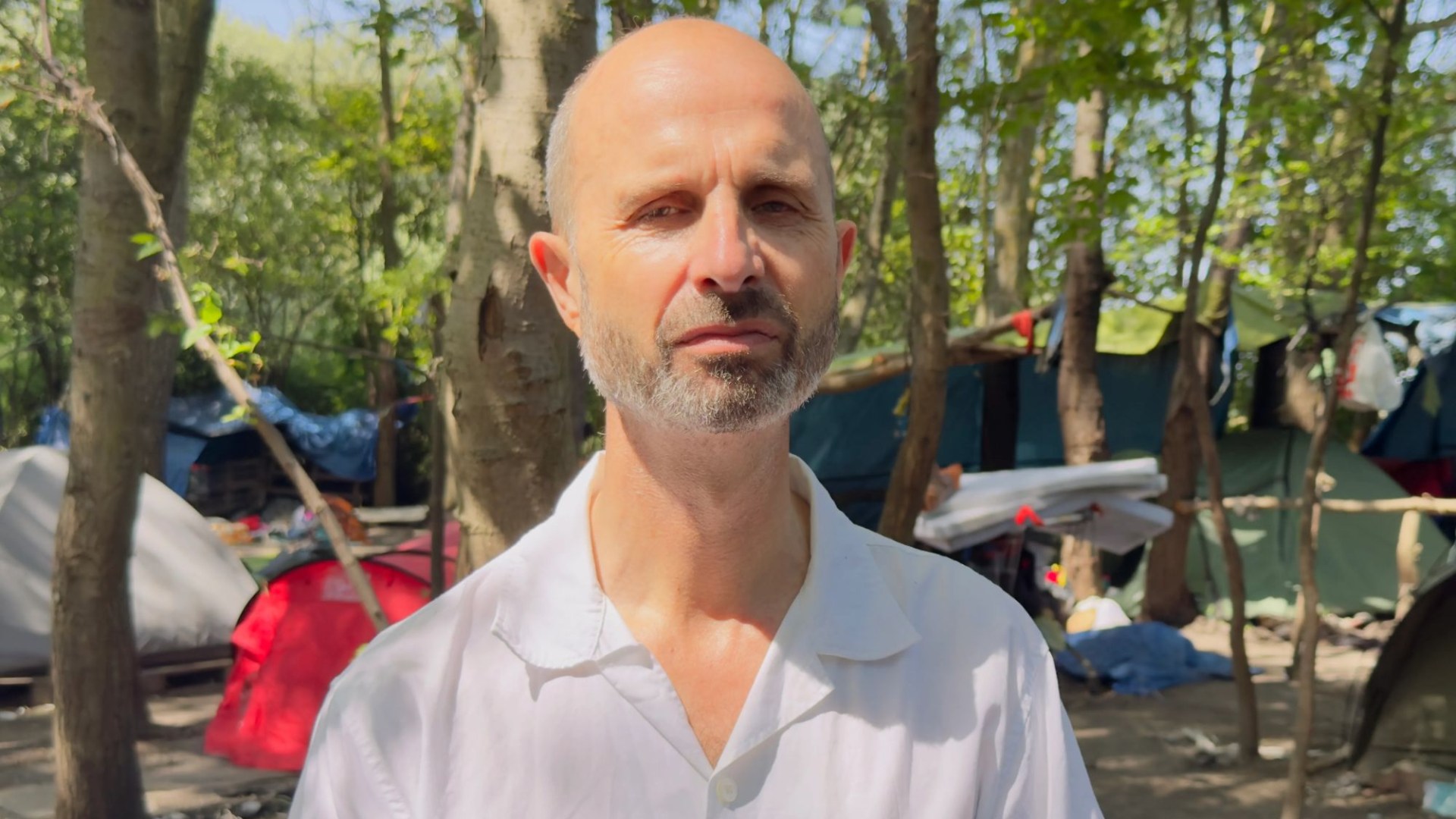
A few minutes before our car was targeted, we had been in a patch of woodland at the sprawling camp when we chanced upon Ethiopian David Sitotan raking up discarded debris and foliage on the forest floor.
Despite his dismal lodgings being a cramped and leaky tent, he wanted to make the best of his surroundings.
Fleeing war and political repression in his beleaguered homeland, this chatty and amiable character far away from home liked to fill his days productively.
Happy to pose for a picture, David, 22, told me: “I don’t just want to hang around reading social media so I decided to tidy up the camp.”
With a crucifix dangling from his neck, he added: “I’m desperate to work when I get to Britain. I have experience servicing mobile phones, as a forklift driver and in a clothes shop.“
Back in the early 2000s when I first visited the camps here, those seeking a new beginning in Britain – whether fleeing war, political repression, or just looking for a better life – would stow away on lorries, vans, cars or trains.
To prove how lax security was at the Channel Tunnel, I even sneaked into the UK that year hidden behind some old crates in the back of a white van.
The van was stopped by French border officers.
8
8
One even climbed into the back of the vehicle but failed to discover me.
We were simply waved through by British officials at the UK border without any checks.
Then, in the spring of 2014, I witnessed mayhem unfurling as dozens of migrants attempted to clamber onto lorries queuing on the N216 dual carriageway to enter the Calais ferry port.
In broad daylight and in full view of British holidaymakers, one young Afghan in his 20s emerged from a shallow ditch beside the busy road and crawled under a Polish HGV as it edged along.
Then he carefully hoisted himself on to the lorry’s spare tyre and clung on as the UK-bound truck picked up speed – his leg dangling perilously close to the road below.
We last saw the truck heading towards the French border crossing at the busy terminal.
When we returned to our car, the vehicle was again pelted with stones by a migrant.
On another visit to the area, myself and a photographer had our motor surrounded, with one migrant splaying themselves on the bonnet.
Others then attempted to smash the vehicle’s windows with stones held in their palms.
It was unclear on either occasion whether our assailants were connected to the smuggling gangs.
Yet the criminality entwined in the people smuggling industry breeds violence.
The huge numbers of migrants arriving on France’s northern shoreline means many wait weeks or even months before securing passage to the UK.
In 1999 the sheer mass of humanity led the French government to help open a Red Cross centre in Sangatte, a village about a mile from the Eurotunnel entrance .
The idea was to provide humanitarian assistance.
As thousands arrived at the centre it was soon being nicknamed the Departure Lounge and the UK government claimed it had become a springboard for people trying to enter Britain.
It was shuttered in 2002.
After Sangatte’s closure, many of the migrants simply moved into dense woodland surrounding Calais.
Christened The Jungle by its inhabitants, it was a squalid and unsanitary sprawl of discarded rubbish, rotting food and open air latrines.
The authorities battled to break up the shanty town but by 2015 it morphed into a vast, 5,000-strong encampment built on a 44-acre former landfill site east of Calais port.
The makeshift camp seemed to be becoming permanent.
It had a theatre, a library, places of worship, hairdressers and a selection of eateries.
Critic AA Gill even visited to pen a restaurant review.
The French initially tolerated the slum settlement but it proved a magnet for migrants using Calais as a jumping off point for the UK.
Amid rioting and arson, the camp was finally bulldozed in October 2016.
Increased security at ferry ports meant criminal syndicates began sending inflatable dinghies across the Channel from 2014.
Migrants then moved up the coast to form camps around the port of Dunkirk.
A tented settlement began forming in scrub between a railway and a dual carriageway not far from the village of Loon-Plage.
It became known as The New Jungle.
A waystation for migrants travelling to the UK, it’s also a bazaar for venal people smugglers seeking to amass human cargo.
Regularly raided by cops, the tents and stalls are dismantled but simply pop up again further east.
Smuggling cartels here often resort to firearms to settle their differences.
Migrants have often told me of their fears as gunshots ring out after dark.
There have been a string of murders and knee cappings as gangs fight turf wars over the smuggling business which is estimated to have grossed a billion pounds in a decade.
These roughnecks think nothing of sending families on flimsy vessels into the world’s busiest shipping lanes.
Back in November 2021, I met Iraqi Kurdish mum Khazal Hussein and children Hadiya, 22, Mubin, 16, and seven-year-old Hasty in a freezing field close to the New Jungle.
Wrapped in scarves and wearing woolly hats, they seemed full of hope despite the awful conditions.
They were happy to chat and pose for pictures.
Big sister Hadiya, 22, an art student, told me she wanted to be an actress, adding: “In Iraq, we have no money. We just want a good life.”
Little Hasty, wearing a pink kitten hat and winter overalls, giggled as she played as if on a camping trip.
I took a snap on my phone as she swung on the ropes of the family’s tent.
Three days later I received the devastating news that Hasty, her siblings and her mum were all dead.
The young family were among 31 lost in the deadliest small-boat crossing disaster recorded in the Channel.
Yesterday 14 people went on trial in Paris facing charges including manslaughter and criminal conspiracy over the tragedy.
The investigating judge accused the majority of the defendants of taking part in “the launching of a low-quality small boat, not certified, unfit for navigation on the high seas, overloaded and lacking suitable life jackets.”
Most deny any wrongdoing.
Some insist they were migrants rather than people smugglers.
More than 17,000 migrants have crossed the Channel so far this year.
Numbers are dramatically down on 2025 yet overcrowding on the deathtrap small boats is increasing.
Last month a grim new record was established when 230 people were crammed onto a so-called mega-dinghy by gangsters.
RECOMMENDED STORIES
Despite tough pledges by a succession of British governments to Stop the Boats and Smash the Gangs – and over a billion pounds funneled to the French to police the Channel coast – the New Jungle still stands.
A shanty town of misery and menace where the desperate are preyed upon by the villainous.