
Advertisement
Flagship Minerals could hardly have picked a better time to get its hands on a potentially billion-tonne copper system.
The company swooped on the Whipsaw copper project in British Columbia (BC) in June for just A$6.5 million, securing a project where historical drilling has already pointed to serious scale just 17 kilometres from Hudbay Minerals’ massive operating Copper Mountain mine.
A lot has happened since to make that deal worth another, much closer look.
Copper has punched to a fresh record US$14,703 (A$20,364) a tonne on the London Metal Exchange, eclipsing January’s US$14,527.50 (A$20,178) peak as mine supply concerns collide with growing demand from power grids, electric vehicles, data centres and artificial intelligence. The red metal’s price has been boosted even further by continued talk of US tariffs.
Advertisement
At the same time, Canada appears to have rediscovered its appetite for building mines.
BC has put that push at the heart of its Look West Strategy, launched last November to accelerate major projects, attract investment and reduce reliance on the US economy. Mining and critical minerals are firmly in its sights, with the broader strategy targeting C$200 billion of major-project investment by 2035.
And there are already some runs on the board.
The BC Government says coordinated assessment and permitting has cut major mining application timelines by 35 per cent. Skeena Resources’ Eskay Creek gold-silver mine redevelopment went from application to decision in nine months, more than 40 per cent faster than previous processes, while Centerra Gold’s Mount Milligan copper-gold mine life extension and plant expansion approvals took only 10 months, 60 per cent quicker than before.
The State has also introduced fixed 40-to-140-day processing targets for mineral exploration permits from April this year, backed by escalation to the chief permitting officer if deadlines are missed.
Advertisement
The changing attitude is showing up almost on Whipsaw’s doorstep. Hudbay’s New Ingerbelle expansion at its Copper Mountain mine received key provincial permits in February before breaking ground in June. It is one of five major mines permitted since Look West was launched.
None of that gives Whipsaw a regulatory free kick, with environmental approvals and First Nations consultation remaining critical; however, the political winds are clearly blowing more favourably towards exploration and mine development.
So, what exactly did A$6.5 million buy?
Flagship secured the right to acquire 100 per cent of Whipsaw, which carries a drill-supported exploration target of 510 million tonnes to 1.02 billion tonnes grading 0.2 to 0.4 per cent copper equivalent.
The target is backed by 58 historical drill holes across a mineralised system 3.7km long and up to 1.2km wide. Standout hits from previous drilling include 283.47 metres at 0.28 per cent copper equivalent from 70.1m, 193.7m at 0.30 per cent copper equivalent from 4.42m and 124.93m at 0.33 per cent copper equivalent from 26.3m. Mineralised structural and skarn zones outside the target add further upside intrigue.
Advertisement
The exploration target remains conceptual and is not a mineral resource. However, Flagship has inherited plenty of evidence of scale before its own modern drilling gets properly stuck in.
In addition to the A$6.5M buy-in, a further A$5 million becomes payable only if Flagship defines a 300-million-tonne JORC mineral resource averaging 0.4 per cent copper equivalent – a sizeable extra cheque that only gets written if Whipsaw clears a serious geological hurdle.
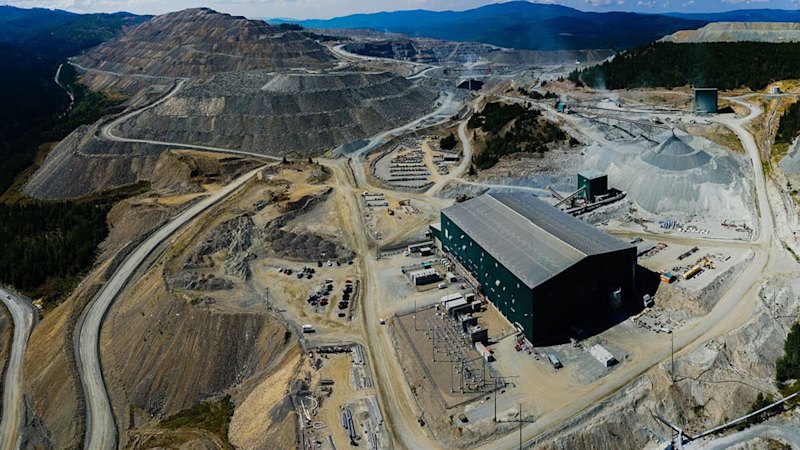
Adds another solid verification layer, Whipsaw sits just 17km to the west of Hudbay’s huge Copper Mountain mine, which produced 23,784 tonnes of copper last year and is targeting 25,000 to 35,000 tonnes this year. Hudbay is expanding the operation through the New Ingerbelle project, which is expected to deliver about 750,000 tonnes of copper, 900,000 ounces of gold and 5.5 million ounces of silver over its mine life.
Intriguingly, the ground between Whipsaw and Copper Mountain isn’t a geological blank. Collective Metals’ Princeton project sits immediately east of Whipsaw and 10km west of Copper Mountain, where exploration has identified porphyry-style targets, copper anomalism and a large magnetic feature comparable to the one associated with Copper Mountain.
Roughly 56 kilometres to the north-east, Kodiak Copper’s MPD project has defined 82.9 million indicated tonnes grading 0.39 per cent copper equivalent and another 356.3 million inferred tonnes at 0.32 per cent copper equivalent.
Advertisement
Further north, 134km from Whipsaw, Teck’s giant Highland Valley operation contains 2.22 billion tonnes grading 0.26 per cent copper with molybdenum credits. It produced 127,100 tonnes of copper last year and its sanctioned extension is expected to keep it running through 2046.
In short, the neighbourhood makes its point. Whipsaw sits in established elephant copper country, where big porphyry systems have continued to move successfully from exploration into long-life production.
The market is also putting serious money behind emerging BC copper stories, with veteran resource investor Rick Rule recently highlighting that mining revival. Barrick, for example, invested C$20.9 million (A$21M) in Kingfisher Metals following its Highway 37 porphyry discovery, taking a 9.9 per cent stake and warrants that could lift its interest to 14.1 per cent. Barrick also secured strategic rights around future funding and the project.
Kingfisher has a market capitalisation of C$176 million (A$176M) despite Highway 37 not yet having a resource, while Amarc Resources, valued at C$228 million (A$229M), has Freeport-McMoRan funding exploration of its emerging copper-gold systems.
Further along the curve, the C$1.45-billion Northisle Copper and Gold shows how the valuation conversation can change as geological certainty firms up. Its North Island project contains 1.2 billion indicated tonnes carrying 10.1 billion pounds of copper equivalent, including a 405-million-tonne higher-grade component grading 0.50 per cent copper equivalent.
Advertisement
Those heady numbers cannot simply be pasted onto Whipsaw, with grades, metallurgy, infrastructure, economics and development risks all playing their part. However, they show how the market can progressively revalue big copper systems as drilling turns geological promise into something more tangible.
That matters because Flagship is evaluating spinning Whipsaw into a standalone ASX-listed copper vehicle, potentially including an in-specie distribution to existing shareholders, subject to the necessary approvals.
Flagship is currently worth around A$69 million yet, tellingly, peer analysis of its Isidora gold project in Chile attributes no value to Whipsaw in the company’s current market capitalisation.
A spin-out could therefore put Whipsaw under a serious market spotlight of its own, while potentially leaving shareholders exposed to both Isidora’s 2.1 million ounces of gold and a separately valued Canadian copper vehicle.
Before that day arrives, though, there is still plenty for the drill bit to sort out, alongside resource conversions, higher-grade zones, metallurgy and ultimately economics.
Advertisement
However, an A$6.5 million ticket into a potentially billion-tonne copper system, 17km from an expanding mine, with prospective copper ground in between, looks particularly interesting, especially in light of record-high copper prices and British Columbia’s genuine urgency to get mines built.
If the drill bit can turn enough of Whipsaw’s conceptual tonnes into real ones, Flagship’s June deal could yet prove one very well-timed swing.
Is your ASX-listed company doing something interesting? Contact: [email protected]
You have reached your maximum number of saved items.
Remove items from your saved list to add more.
More:
AdvertisementAdvertisement