
Anglican Church’s first female Aboriginal priest and prolific Arnhem Land artist dies aged 91
Posted Wed 9 Sep 2026 at 3:00pmWed 9 Sep 2026 at 3:00pmWed 9 Sep 2026 at 3:00pm
A pioneer within the Anglican church has been remembered by her family as a “strong cultural woman”, after she passed away this week in the Northern Territory.
Aboriginal and Torres Strait Islander readers are advised that this article contains the names and images of an Indigenous person who has died, used with the permission of her family.
Reverend Y. Nunggumajbarr died on Monday at Gove District Hospital in the Northern Territory’s north-east Arnhem Land after a cancer diagnosis.
Reverend Y. Nunggumajbarr was ordained as an Anglican priest in 2009 at a ceremony in her home community of Numbulwar, on the Gulf coast in south-east Arnhem Land.
In 2011 Reverend Y. Nunggumajbarr was featured on the ABC’s Compass program for her work as the “Arnhem Land priest”.
The Reverend told the program that she was born on her “motherland” of Wuyagiba, and as a girl travelled with her parents to live at what was then the Roper River Mission, which after flooding was moved to a site that is now the community of Ngukurr.
It was there she began her life in the church.
“Every Sunday we were going to the church, listening to the word of God,” she said.
In 1974, she began her training towards priesthood at Nungalinya College in Darwin where she studied theology and linguistics.
“I said to myself I know that God want me to go to Nungalinya college,” the Reverend said.
In an email sent to members of the Anglican Dioceses, Bishop Greg Anderson said Reverend Y. Nunggumajbarr had ministered services in nearby Angurugu and Numbulwar for more than a decade, prior to her retirement from the ministry in 2023.
“Her constant focus was on the work of the gospel, and what needed to happen to make it spread,” Bishop Anderson wrote.
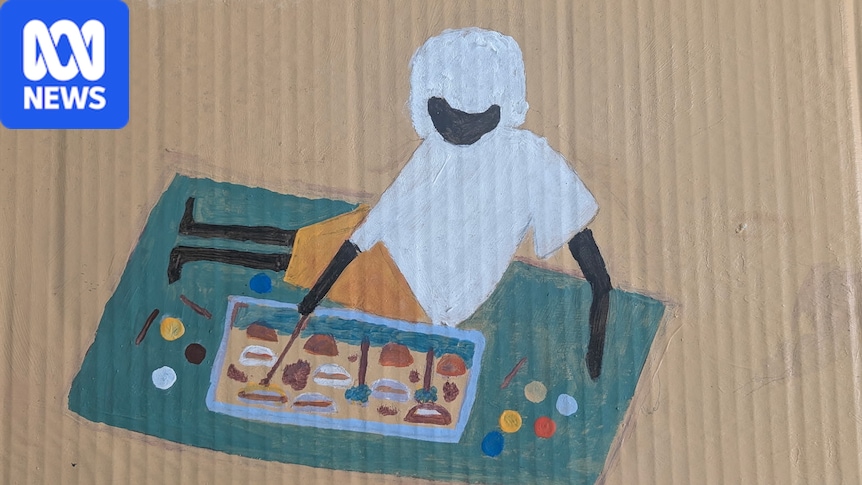
In her later years Reverend Y. Nunggumajbarr practised pandanus weaving and painting at the Numbulwar Numburindi Art Centre.
“She was well known through her cultural side,” her daughter Hilda Ngalmi said.
In a video published by the art centre in 2021, Reverend Y. Nunggumajbarr said she began selling her pandanus weavings during the first years of the Numbulwar Mission in the 1950s and 1960s.
“We do weaving because we want to talk about things for ourself and for our children, who we are and where we come from,” she said.
‘Much more than artworks’
Numbulwar Numburindi Arts centre manager Adélaïde Keraldy said the news of Reverend Y. Nunggumajbarr’s passing had come “with great sadness and a very heavy heart”.
“[Reverend Y. Nunggumajbarr] was one of those people whose presence shaped the life of our art centre,” she said.
“She was a strong woman, an artist, a storyteller, and an important part of our community.“
Ms Keraldy said there was “something very special in the way [Reverend Y. Nunggumajbarr] made art” and “something special about her”.
“Her work was never separate from life,” she said.
“It came from what she knew, what she had seen, what she felt, the places she belonged to and the stories she carried with her.
“We feel incredibly lucky to have spent time with her, to have listened to her stories, to have seen her dance and sing, to have watched her create, and to have helped her artworks travel far beyond Numbulwar.”
But Ms Keraldy said Reverend Y. Nunggumajbarr left behind “much more than artworks”.
“She leaves a legacy, memories, knowledge, stories and a presence that will remain with us,” she said.
“Numbulwar Numburindi Arts will not feel the same without her.”
Australian Anglican primate Mark Short said the church thanked God for Reverend Y. Nunggumajbarr’s “long and faithful ministry”.
“That ministry impacted not just her community at Numbulwar but the whole church through her membership of the National Aboriginal and Torres Strait Islander Anglican Council,” he said.
“As a female Aboriginal priest she was a pioneer and I pray many others will be inspired to follow in her footsteps.”
Reverend Y. Nunggumajbarr is survived by her six children, 17 grandchildren and according to her daughter, “heaps” of great-grandchildren.