
Australians forced to sleep at London’s Heathrow Airport after air traffic control failureBy national tourism reporter Kristy Sexton-McGrath
Posted Wed 9 Sep 2026 at 9:52amWed 9 Sep 2026 at 9:52amWed 9 Sep 2026 at 9:52am
In short:
Hundreds of flights have been cancelled and the plans of tens of thousands of passengers disrupted after an air traffic control failure across the UK.
The fault has been fixed, but Australian travellers are among those facing delays and cancellations as airlines clear a major backlog.
What’s next?
UK airports and airlines have warned disruption could continue on Wednesday as aircraft and crews are repositioned.
Australian travellers have been left stranded in one of the world’s busiest airports after an air traffic control failure led to flights being cancelled across the United Kingdom.
Up to 1,000 flights were cancelled on Tuesday, according to tracking website FlightRadar24, and delays are expected to continue throughout today as airlines work through a significant backlog.
The disruption was caused by a fault in the flight data processing system operated by the UK’s air traffic control provider, National Air Traffic Services (NATS).
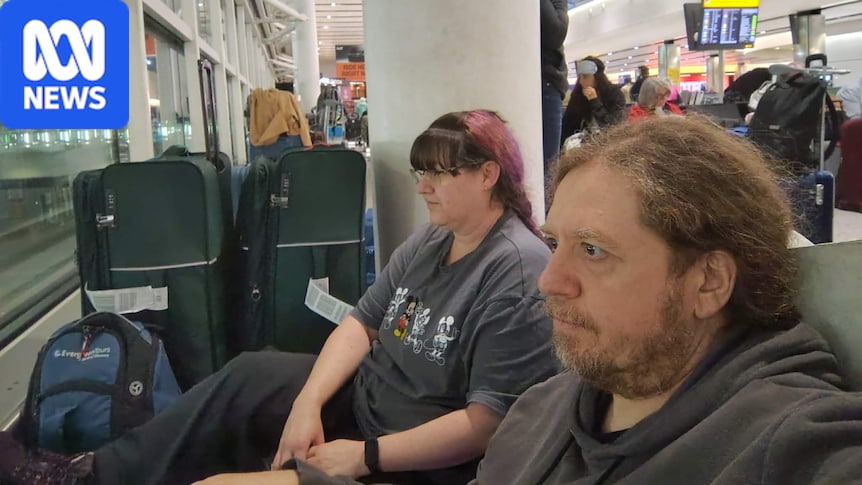
Perth woman Monique Whiting and her partner Frank are sleeping on the floor at London’s Heathrow Airport following the cancellation of their flight to Iceland.
The couple boarded their Icelandair flight shortly before 1pm local time and remained on the aircraft for more than four hours before being told to disembark.
“We knew pretty early on that there was a bit of a delay, and I could see through the window that there was a bunch of planes lining up to go,” Ms Whiting said.
She said the airline provided snacks and water, but late in the afternoon passengers were told the flight would not be leaving.
Ms Whiting said Icelandair told passengers to arrange their own accommodation and offered to reimburse them up to a certain amount, but there was no vacancy at nearby hotels.
“A bunch of other things had already been cancelled and a lot of the close-by accommodation was obviously already booked out,” she said.
“You can imagine how busy it is and there’s lots and lots of people still at the airport.
“We’re all staying here overnight and not getting any sleep.“
Debbie Payne was four days into a European holiday when she arrived at Heathrow for an 8:50pm flight home to Australia via Singapore.
After travelling to the airport by car, train and the London Underground, she discovered flights had been cancelled.
“People weren’t sure what to do,” she said.
“You just had to wait around and hope.”
Ms Payne said passengers were initially prevented from passing through security, while some travellers were stranded aboard aircraft on the tarmac.
“There were people on planes who couldn’t get off because there were no ramps,” she said.
“It was hard to know what was going on.
“I felt sorry for people who didn’t speak English and those with young babies.”
Backlog to cause further delays
The disruption was caused by a fault in the flight data processing system operated by NATS.
The system processes flight plans and other operational information used by controllers to manage aircraft travelling through UK airspace.
NATS said it had fixed the problem, but warned it was taking longer than expected for normal operations to resume.
Chief executive Martin Rolfe apologised to affected travellers and told the BBC there would be a full investigation.
Flight-tracking website Flightradar24 reported that up to 1,000 flights had been cancelled.
The worst-affected airports included Heathrow, Gatwick, Manchester and Birmingham, while airports in Scotland and Ireland also reported disruption.
EasyJet cancelled about 200 flights and British Airways cancelled or diverted more than 100.
Ryanair said more than 65,000 of its passengers had experienced delays of up to eight hours.