
Advertisement
September 9, 2026 — 5:00am
You have reached your maximum number of saved items.
Remove items from your saved list to add more.
The “National” in the NRL, is a misnomer, considering the code’s finals series has teams in only two Australian states plus Auckland, while the AFL’s play-offs boast teams from every state bar Tasmania.
It promises to be a lucrative series for the AFL, which introduced an historic wild card round and lucked in when powerhouse clubs, Collingwood and Carlton, were among the four teams to qualify, drawing 172,000 extra fans to the MCG.
The NRL isn’t so fortunate without any historic rivalries in the match-ups, yet haven’t officially surrendered staging a play-off for third place as an additional money spinner.
It’s a proposal which warrants being interred in the Mausoleum of Bad Ideas, along with New Coke and Tony Abbott’s award of a knighthood to Prince Phillip. As one coach said, “Both losing preliminary finals teams would be disappointed after missing the grand final and still half pissed from drowning their sorrows.”
Advertisement
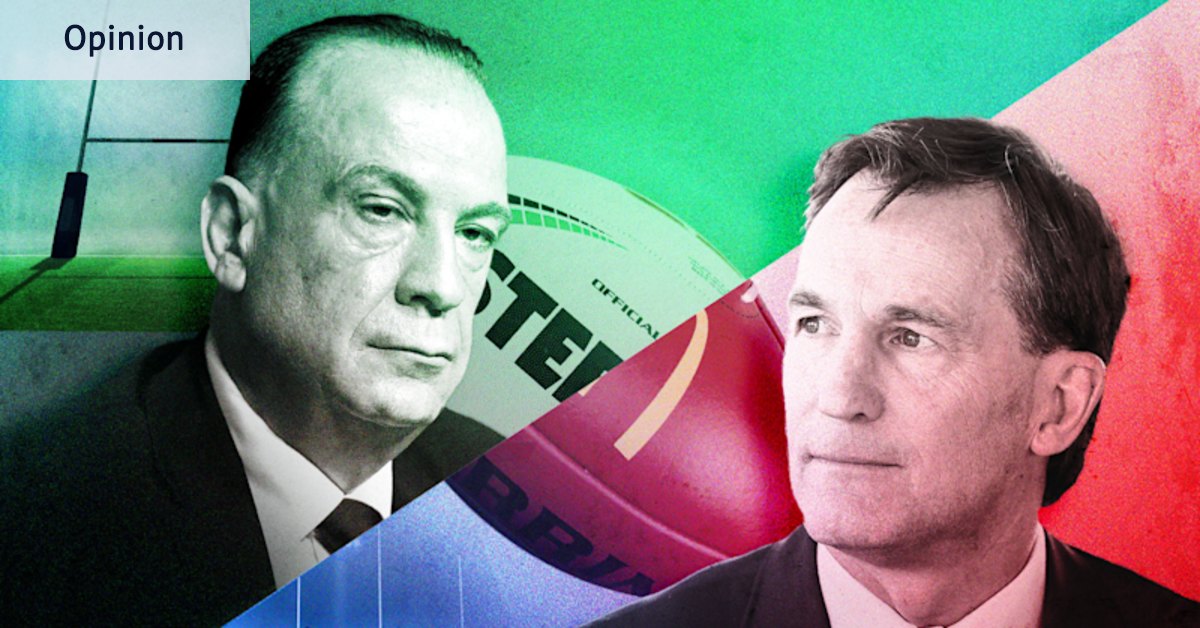
The idea of a wild card round came from AFL management, whereas the NRL play off for third place has been pushed by ARL chair Peter V’landys. They reflect how decisions are made in the rival codes. Each is governed by a commission but the AFL administration has historically called the tune, particularly during the reign of chief executive and man about town Gillon McLachlan and, earlier, the confrontational Andrew Demetriou.
The NRL is a one-man band. The AFL, without strong oversight from a board and the NRL, without a challenging executive, renders both codes vulnerable to rebellion.
Rugby League Central won’t make a major decision until approved by V’landys. By contrast, AFL management is traditionally proactive, awarding the MCG hosting rights to the AFL grand final to 2059, a proposal rubber-stamped by the commission.
Ditto a management veto of a twilight grand final. Whereas V’landys takes an active role in selection of Australia’s team, it is unlikely AFL chair Craig Drummond would be seen arguing with selectors over the composition of the All Australian squad.
Advertisement
V’landys has been the vocal driver and defender of rule changes, including the contentious six again revolution. Headlines in Melbourne papers begin “AFL …”; Sydney ones banner PVL.
It’s a paradoxical situation, given the football experience on both commissions.
Drummond is a former Goldman Sachs banker and is the Transurban chief. He heads a board of 10 which includes another past club chair, together with two ex players, one of whom served as chief executive of both the Swans and Lions. AFL chief executive Andrew Dillon is also a commissioner.
V’landys heads a board of eight, with only Wayne Pearce, a former player and coach having any experience working at an NRL club.
Advertisement
The ARL constitution prohibits the NRL chief executive being a commissioner.
While the AFL commission is “very Melbourne” where company directorships, private schooling and family history count in corporate connections.
V’landys describes himself as “a migrant kid from Wollongong.”
He is pragmatically Sydney, using his position as chief executive of Racing NSW and the hospitality of his executive suite at Royal Randwick Racecourse to network.
Advertisement
With the departure of former NRL chief executive Andrew Abdo to head Tennis Australia, V’landys has taken leave from Racing NSW to install himself as executive chair, meaning he both heads the board and is acting chief executive.
V’landys described Abdo’s position needing someone who is “a Superman and Jesus”.
Presumably, with himself also being chair, he is a superhero, saviour and holy spirit.
Executive chair is an acting position because the code’s constitution prohibits a commissioner having a paid management role.
Advertisement
The NSWRL and QRL have each sought separate legal advice on his position as executive chair. Lawyers for both have confirmed it is counter to the constitution and good corporate governance.
Despite this, V’landys has recently taken a strong stance against competing interests, particularly with media and football roles. Yet, in his capacity as chief executive of Racing NSW, he told a Senate inquiry into gambling that punting on the horses wasn’t the problem: it was poker machines.
Most NRL clubs are supported by licensed clubs that survive on poker machines.
How long he continues in the executive role after his four months long service leave from Racing NSW expires is uncertain. He can’t receive the $1.55m salary paid to Abdo but does receive a $200,000 fee as chair.
By comparison, AFL executive salaries are stratospheric. In Demetriou’s last year as chief executive (2014), he was paid $3.8m. The AFL board, under Drummond’s predecessor, Richard Goyder (who was also chair of Qantas during the reign of Alan Joyce) opted not to disclose salaries paid to senior management, despite public companies publishing similar monies paid to their executives.
Advertisement
Dillon doesn’t have the presence of his AFL predecessors. He begins many a sentence at a media conference with, “Oh look …” but rarely gives you anything to see.
Meanwhile, V’landys looks every bit the supreme leader of the NRL, running a largely atrocity-free code under his reign. V’landys says the AFL, or the FLA as he likes to call the code, “always look down their nose at us.”
He is right when it comes to crowds and the AFL’s finals figures will fuel this superiority.
V’landys has bettered the AFL with his recent broadcast deal, but resistance from players over the rules shortening their careers is growing. V’landys is very rugby league in that he knows the game can turn on you quickly. You can be canonised one year and cannonaded the next.
Sports news, results and expert commentary. Sign up for our Sport newsletter.
You have reached your maximum number of saved items.
Remove items from your saved list to add more.
More:
Roy Masters is a Sports Columnist for The Sydney Morning Herald.Connect via email.AdvertisementAdvertisement