
Commuting isn’t exactly relaxing. It involves pretty much every unsettling sensory experience going, from the screech of the Tube to the bustling of bodies on the platform — all while you’re still waking up.
Now, Ealing Broadway Tube station is attempting to make travelling a little bit less stressful by trialling a designated ‘calm space.’
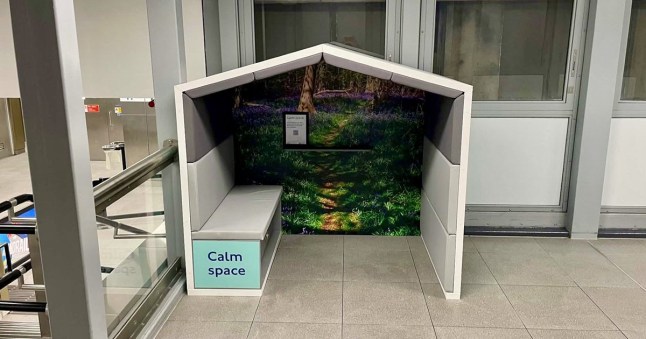
The area, which doesn’t have any doors and is almost akin to an office meeting pod, has one small bench.
There’s soft padding inside to insulate the sound, and a covered roof to bat off any extra noise.
It’s been designed as a ‘low-stimulation’ environment where commuters can take a few minutes out if they need to, complete with calming, nature-inspired colour palettes. There’s also room to accommodate mobility aids, buggies and assistance animals, as well as level access for wheelchairs.
The space, which was designer by working directly with neurodivergent people, will be at the West London station until October 2, and customers will be encouraged to give feedback on their experience.
There’ll be another following in Covent Garden this autumn, which will be rolled out inside the London Transport Museum.
As someone with ADHD, I’m prone to feeling overstimulated quite often.
Most recently, I’ve developed a strong aversion to the click-clack of hard-soled shoes on the platform. I’m also a fairly anxious person, and sometimes I’ve found myself so overwhelmed that I’ve just started crying right in the middle of a ticket hall, stifling a panic attack in my chest.
I know this is a me problem, and I don’t expect anyone to change their wardrobe on my account. But nor do I think this new pod would help me.
During these moments, I would absolutely appreciate a quiet space to sit, take five, and recompose myself to the point where I can get on a train.
But in order to do that, I would argue some privacy is needed.
Latest London news
- Met Police refuse to say if they are investigating London upskirting website
- Man, 32, dies after ‘violent attack’ at major London station
- Londoners can hail a limited Uber Wayve robotaxi after new trial starts
To get the latest news from the capital, visit Metro’s London news hub.
This is the issue I have with this particular calm space. Disabled people absolutely need these types of accommodations, and we aren’t given them enough. However, we do need to get them right.
POLL
Poll
Would you try a ‘calm space’ inside a Tube station?
-
YesCheck
-
NoCheck
If I’m in the depths of an anxious moment, probably with tears streaming down my face, I don’t really want to broadcast it to everyone else who also happens to be passing through the station. It wouldn’t soothe me, nor would it help me feel better.
And if there’s no door, that will arguably only contribute to the issue of overwhelm, because it’s not filtering out any of the noise.
Sometimes, I just want somewhere I can quietly hide, away from the nosy eyes of the general public.
The intention is inclusive and thoughtful, but the execution isn’t quite there.
On social media, other people agreed that, while its a step towards a more inclusive world for neurodivergent people, it hasn’t quite been implemented properly.
As the mother of an autistic son, TikToker @fionn.mac.cumhail4 described it as ‘nice, but [it] won’t do s***,’ while another commentator said it was ‘literally right next to the stairs that lead to the platforms,’ so ‘it’s still going to be noisy.’
Meanwhile, @agujiegbe worried the space would be misused, writing ‘give it five mins and some idiot will sit there taking a phone call on loudspeaker at full volume.’
‘I’m not sure what makes this a calm space’
Hester Grainger, an ADHD coach and the co-founder of Perfectly Autistic, shares similar views.
She tells Metro: ‘I love the idea of calm spaces in principle, and anything we can do to have conversations around autism and neurodiversity as a whole is hugely positive. But I’m not sure what makes this a calm space.
‘People will still be whizzing by on their journey. What if more than one person wants to sit in the calm space? It all of a sudden becomes cramped, and the person on the inside can’t get out.
‘It’s a nice idea – but probably needs to be a quiet room rather than a quiet space.’
Hester says in order to be effective, a calm space needs to be easy to locate, with clear signage to avoid piling on even more stress. And while I’d be reluctant to have mine — or anyone else’s — distress explicitly labelled for everyone else to see, it’s a fair point.
‘I’d make it really clear what the space is for, so it doesn’t just become somewhere people go to sit on their phones or take a call. Ideally, people should be able to use it without having to justify why they need it.’
She adds: ‘It should feel genuinely calm, with softer lighting, less noise, and comfortable seating.
Other examples of these quiet spaces include a designated tent at Glastonbury Festival (which provided a similar space, amid one of the most chaotic environments I’ve ever set food in).
There’s also one inside the St Enoch Shopping Centre in Glasgow.
An accessible and inclusive capital city
Nonetheless, there’s a reason accommodations like this are so necessary.
To come up with this specific design, TfL partnered with UK-based autism charity Autistica, who worked closely with neurodivergent people through workshops and focus groups.
The aim was to understand how spaces like these can actively benefit neurodivergent people.
Dr Debbie Weekes-Bernard, London’s deputy mayor for communities and social justice, said: ‘Busy stations can be overwhelming for many customers using the capital’s transport network, and that can make travelling across our city feel daunting.
‘As we build a better London for everyone, the Mayor and I are determined to break down barriers to ensure our capital is as accessible and inclusive as possible.’
And it’s true: London does need to be more inclusive for disabled people.
Not every Tube station has step-free access, which means those with mobility issues are unable to use certain stations through no fault of their own. There need to be more toilets with Changing Places facilities, and access to accessible housing needs to be expanded.
Broadly, this is a step in the right direction, but we need to, firstly, ensure these calm spaces are actually serving all neurodivergent and disabled people, and secondly, consider rolling out more across the capital.
Just one inside a station in suburban West London, and one inside a museum, isn’t going to solve the plight of Londoners with ADHD and autism overnight.
It is, however, a very good start, and Mayor of London Sadiq Khan has pledged £3 million per year for five years to improve TfL facilities, which includes improved toilet facilities at the likes of Morden and Seven Sisters.
Inevitably, there’ll be trolls who write off accommodations like calm spaces as exclusively for ‘snowflakes’; a sign that younger generations are becoming too soft.
But the world becoming more inclusive doesn’t just help neurodivergent people; it normalises the idea that it’s okay to find things difficult sometimes, and it’s okay to ask for help.
Battling an overwhelming commute is just one of the first steps forward.
Do you have a story you’d like to share? Get in touch by emailing [email protected]
Comment now
Comments
Add Metro as a Preferred Source on Google
Add as preferred source