
This section is The content in this section is supplied by GlobeNewswire for the purposes of distributing press releases on behalf of its clients. Postmedia has not reviewed the content. by GlobeNewswire Article content
- Unlevered after-tax NPV8 and IRR of US$5.0 billion and 24%, respectively
- Up to 70,000 tonnes per year of battery-quality lithium carbonate production
- Capital intensity of $49.9k per tonne with average annual cash operating cost of $4,226 per tonne
- Upgraded and upsized Mineral Resource with some of the highest lithium-in-brine concentrations reported in North America
- Potential to increase the scale and value through bromine and potash commercial opportunities
Sign In or Create an Account
or View more offersArticle content
Story continues below
This advertisement has not loaded yet, but your article continues below.
Article content
LEWISVILLE, Ark., Sept. 08, 2026 (GLOBE NEWSWIRE) — Smackover Lithium, the partnership between Standard Lithium Ltd. (“Standard Lithium” or the “Company”) (NYSE.A: SLI) (TSXV: SLI), through its subsidiaries, and Equinor, through subsidiaries of Equinor ASA, announced today the positive results of a Preliminary Economic Assessment (the “PEA”) for the Franklin project (“Franklin”, the “Project”, or the “Franklin Project”) in the northeast region of Texas, USA.
Article contentWe apologize, but this video has failed to load.Try refreshing your browser, or
tap here to see other videos from our team.Article contentArticle content
The PEA for the partnership’s first Project area in the East Texas region of the Smackover highlights the globally significant size and high quality of its brine position. It marks a key step towards the partnership’s goal of reaching well over 100,000 tonnes (“t”) of lithium chemical production per year in Texas through multiple phases and projects.
Article content
PEA Highlights:
Article content
- Robust lithium project economics. Unlevered after-tax net present value (“NPV”) of $5.0 billion, an internal rate of return (“IRR”) of 24.0%, and a 3.1-year payback period, assuming a discount rate of 8% and a lithium carbonate price of $22,400 per tonne (“/t”).
- Globally significant production scale. The PEA contemplates annual production capacity of up to 70,000 tonnes of battery-quality lithium carbonate and roughly 65,000 tonnes per annum (“tpa”) of average production over a 20-year modelled operating life, with an average lithium concentration of 515 mg/L. Initial production could begin in the early 2030’s with additional potential for a longer operating life and further expansion, though this is not modelled in the PEA.
- PEA leverages Definitive Feasibility Study (“DFS”) for the South West Arkansas Project (“SWA Project”). The SWA Project DFS was informed by an 18-month detailed front-end engineering design process. Due to the similarity of the brines within Standard Lithium’s suite of projects, it is possible to apply key elements of the SWA Project process flowsheet and costing to improve understanding and accelerate the PEA process for the Franklin Project.
- Competitive operating cost estimate. Average annual lithium cash operating costs of $4,226/t projected over the operating life, and average annual all-in costs, inclusive of cash operating cost, royalties, sustaining capital and closure costs, of $5,054/t (see Table 3).
- Capital requirements. Lithium initial capital cost estimate (“CAPEX”) of $3.5 billion, including contingencies of 20%. This estimate takes into consideration SWA Project costs and uses established methodologies and scaling factors that result in a capital intensity of $49,945/t and incorporates Standard Lithium’s continual Demonstration Plant learnings.
- Increased exploration activities support larger and improved Mineral Resource definition. Increased Mineral Resource size and a portion of the Mineral Resource converted from Inferred to Indicated as compared to the Maiden Inferred Resource Report (“MIRE”). The new Indicated Resource is 1.77 million tonnes lithium carbonate equivalent (“LCE”) at an average lithium concentration of 562 mg/L for 0.59 km3 of brine volume, while the upgraded Inferred Resource is 2.13 million tonnes LCE at an average lithium concentration of 572 mg/L for 0.70 km3 of brine volume. This represents a significant increase in total resource size. The PEA includes an Indicated and Inferred bromide Mineral Resource (ionized form of the commercial product bromine) of 2.66 and 3.15 million tonnes at an average bromide concentration of 4,483 and 4,501 mg/L, respectively, an increase and upgrade from the MIRE. There is also an Inferred potash (as potassium chloride) Mineral Resource of 15.06 million tonnes at an average potassium concentration of 11,291 mg/L (see Table 4).
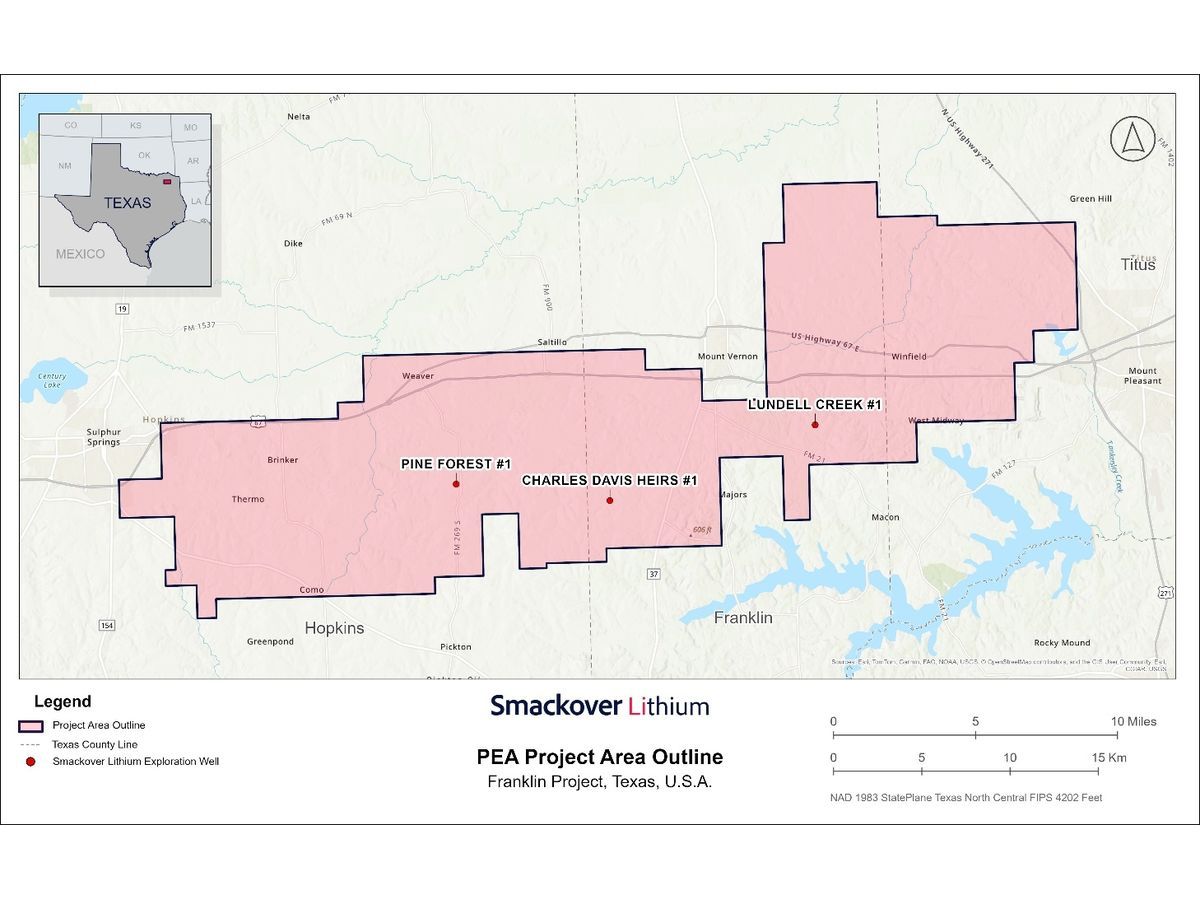
- Extensive brine mineral leasing for the Franklin Project. Brine mineral leasing has been ongoing since 2022 in the Project area now encompassing 44,541 hectares (110,064 acres), an increase of 37% from the 32,455 hectares (80,199 acres) highlighted in the MIRE (see Figure 1). A total 30,994 hectares (76,588 acres) gross mineral area has been leased to support the Mineral Resource.
- Additional value creation potential from bromine. The PEA also considers a scenario based on co-located bromine commercial opportunity of 50,000 tonnes per year.
- Possible future upside from potash. Potash was added to the U.S. Geological Survey Critical Mineral List in 2025. This PEA does not assume any potash recovery, production or economic contribution, but does highlight another possible source of future upside subject to technical, economic and market evaluation.
- All figures are in US dollars and all units are metric unless otherwise stated. All model outputs are expressed on a 100% ownership basis with no adjustments for financing assumptions. Standard Lithium’s economic interest in the Project is 55%. Mineral Resources have been reported in accordance with the 2014 Canadian Institute of Mining, Metallurgy and Petroleum (“CIM”) Definition Standards for Mineral Resources & Mineral Reserves (“CIM Definition Standard”).
Article content
Story continues below
This advertisement has not loaded yet, but your article continues below.
Article content
Dr. Andy Robinson, President and COO of Standard Lithium stated, “The Franklin PEA demonstrates the strength of arguably one of the largest and highest-quality lithium brine resources in North America, supporting an attractive standalone lithium operation with additional potential value from bromine and potash. Continued Project definition through our resource development, processing expertise and mineral leasing activities has resulted in a meaningful increase and upgrade to the Mineral Resource while highlighting very attractive and robust Project economics. These latest results establish a strong foundation to advance the Franklin Project as the first of our planned large-scale critical minerals projects in East Texas and underscore the scale and national importance of the partnership’s broader resource position being developed in the region.”
Article content
Allison Kennedy Thurmond, VP for US Lithium at Equinor added, “Advancing the PEA for the Franklin Project is an important step in unlocking the broader lithium potential for our partnership across the region. We are proud of the team’s disciplined execution and hard work to realize the Project area’s potential. These results strengthen our confidence in the opportunity and position us well to progress the next phase of technical work.”