
Advertisement
When grief strikes, sometimes the only thing to do is whack weeds and feel the fire of a chainsaw.
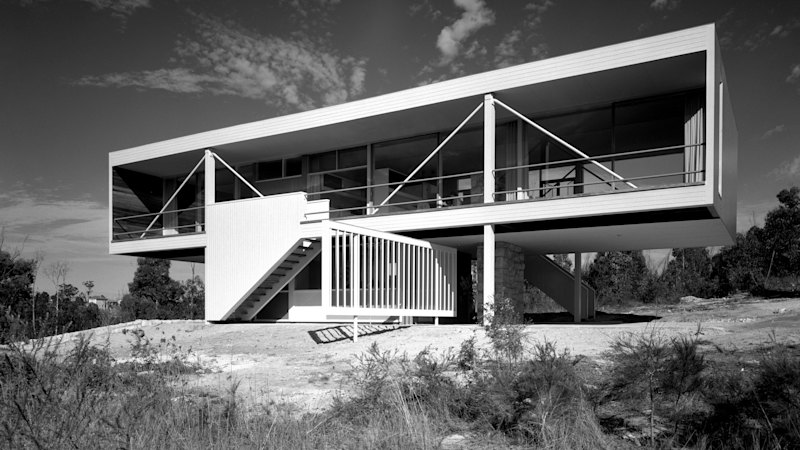
Donna Seidler turned to the garden first when she unexpectedly became the custodian of the 72-year-old modernist Julian Rose House in Wahroonga designed by Australia’s most renowned modern architect, Harry Seidler.
Her husband Brian died in March 2025 after a short illness, before he had finished his restoration of the adventurous cantilevered home – elevated 3.3 metres – that had been designed by his older cousin, Harry.
Brian had spent nights and weekends – after full days as executive director of the Master Builders Association – painstakingly restoring the home with advice from Harry Seidler & Associates’ principal architect Greg Holman.
Advertisement
But Julian Rose House, which Brian had bought from previous owners years ago, was far from complete, said his widow Donna, now in her 50s: “He always told me he was close … he’d been saying that for the past eight years.”
“I thought, oh my gosh, what am I going to do,” she said. “People told me, ‘Just sell up. Don’t put yourself through it.’ But it was Brian’s legacy. And I wanted to do it for him, for myself, and the children.”
She was also acutely aware that it was a home regarded as part of the nation’s cultural history.
It was the second of three buildings Seidler designed for the family on the compound next to bush. The first was the heritage-listed Rose Seidler House, for Harry’s mother Rose. The third, next door, is home to Donna and her three children and where she married Brian, and where her husband grew up.
Advertisement
The Herald reported in 1954 that Seidler had “set his signature on the landscape” with a series of “servant-less” houses – of relatively modest size – that attracted crowds, controversy and contributed to the explosion of homes in the “new style”.
No pressure, much, for Donna, who is neither an architect nor a builder but a human resources manager. Unsure of what to do, she realised that she could get rid of the weeds and bamboo growing up around her own home and Julian Rose house nearby.
“I got the fire in me to get on the chainsaw.”
Advertisement
She also bought a long-handled motorised tree lopper, and a lawn mower.
“I put all that sadness, all that grief into chopping, and opening up a space for me, and always looking at this house – knowing I had to start on it. I felt like I was cutting a path up the hill to it.”
Since Brian died, the time has passed unpredictably. “It’s gone in the blink of an eye, and then sometimes it feels like it’s been centuries,” she said.
Brian had envisaged the house becoming a place for architects to visit and learn. Donna plans to rent the home to people interested in architecture after the 10-year-plus renovation is complete sometime in the next month or two.
Advertisement
When Donna picked up where Brian had stopped, she knew nothing about building. She started with unfinished tiling in one of the bathrooms, turning to YouTube for advice.
She discovered a grout finishing tool at Bunnings that had a little ball that was perfect for the job.
As she worked, she asked herself: what would Brian do? She turned to his plans, drawings and the notes everywhere in his home office. “I am flying as close [as possible] to what Brian prescribed,” she said.
Advertisement
“I have been following the drawings. There are little arrows pointing here and there … with questions like how high that should be.”
Brian had the Seidler eye for detail “down to every nail”, which is why the restoration had taken so long. Over time, she started trusting her judgment. Brian had planned a linen cupboard next to the kitchen and an outside laundry. She overruled that, installing a washing machine and dryer inside.
Small wins became moments of joy. Some original steel window handles and thumb screws had broken. Nobody makes them today so she hunted for a fabricator to make new ones to Harry’s original design.
The Museums of History NSW says Rose Seidler House, built in 1949, introduced Seidler and innovative modernist design ideas to the Australian public.
Advertisement
But it was Julian Rose House, designed in 1951 and built 1953-54, that showed the public’s enthusiasm for modern architecture. It was structurally more daring, too, with its elevated main floor slung from a double cantilevered steel.
Architect Penelope Seidler said she was “extremely happy” with the result. Brian and Donna had faithfully reconstructed all the details of her late husband Harry’s original design. “We were absolutely thrilled that Brian bought the house, and took on the major job of restoration.”
Start the day with a summary of the day’s most important and interesting stories, analysis and insights. Sign up for our Morning Edition newsletter.
You have reached your maximum number of saved items.
Remove items from your saved list to add more.
More:
Julie Power is a senior reporter at The Sydney Morning Herald.Connect via X or email.AdvertisementAdvertisement