
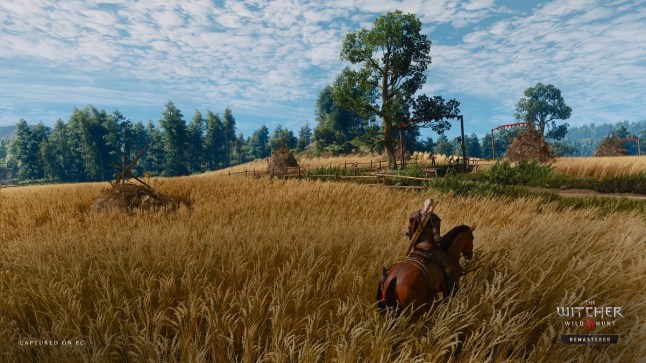
Over a decade after it was first released, The Witcher 3 is about to reclaim its position as the best action role-player of all-time – but did it ever really lose it?
Although fans have long been looking forward to the release of The Witcher 4, suddenly all eyes have returned to The Witcher 3, after Polish studio CD Projekt Red revealed it had one last surprise in store for this year’s Gamescom. Prompted by seemingly nothing at all, they announced to a packed hall that they would be rolling out a massive remaster of The Witcher 3: Wild Hunt at the end of September.
This isn’t just a surface level retouch. In addition to better graphics, you’ll be able to enjoy enhanced combat, better mount handling, more intelligent monster behaviour, and a skill tree revamp. Even better, the whole update is set to be absolutely free, includes the existing two DLC expansions. And that’s not even counting the new expansion, Songs Of The Past, which is set to come out alongside the remaster.
It’s not entirely clear why they’re being so generous – perhaps there’s still residual guilt, or a concern that fans still hold a grudge, over the launch of Cyberpunk 2077 – but it’s a classy move and one that will no doubt engender considerable goodwill.
It certainly did for me, not least because of the new fans this move will hopefully attract. I’ve been playing The Witcher 3 for many years now. It’s my feelgood game, something I can slide easily back into after a month, or even a year, away from it.
Each time I do, there’s a warm buzz of serotonin. Geralt’s world is brutal, unforgiving, and often cruel, but it sure is an excellent place to spend a few hours. Even if most of those hours are spent dodge-rolling fiendishly difficult bosses.
Expert, exclusive gaming analysis
Sign up to the GameCentral newsletter for a unique take on the week in gaming, alongside the latest reviews and more. Delivered to your inbox every Saturday morning.
It’s easy to forget now, but when the game first launched in 2015, it took the industry by storm. At that point Skyrim was only four years old but the scale of The Witcher 3’s world, the complexity and variety of its quests, and the quality of its writing – not to mention the amazing graphics – were light years ahead of the competition.
It went on to scoop over 200 awards, and to date, has sold 65 million copies. To call it a success would be an understatement; the game undoubtedly also incentivised Netflix to create its own The Witcher series in 2021, even if it is nominally based on the original novels and not the games.
To my mind, even a decade later, there’s little else to touch it. The game’s sprawling story is a masterpiece: complex, always surprising, and unexpectedly heartfelt, drawing on the established lore from Andrej Sapkowski’s books to flesh out characters that are remarkably nuanced and complex.
The open world and emphasis on player choice, and the attention to detail in the side quests, are arguably the game’s best elements. The Bloody Baron’s storyline is often cited, but I also have a soft spot for Scenes from a Marriage, the exceptionally creepy questline from the Hearts Of Stone expansion.
It’s not just the quality of the storytelling but the way in which the game consistently manages to surprise. This was clearly a massive labour of love for CD Projekt Red, judging by the amount of Easter eggs hidden in the game’s massive 60-plus hour playtime.
Ever stumbled across Durden the Tailor in the Fists of Fury side quest? That’s clearly a nod to Fight Club’s Tyler Durden. Or the corpse of a dwarf that looks suspiciously like Game of Thrones’ Tyrion in Skellige’s Kaer Almhult?
Or, indeed, the secret quest that opens up if you spare the Doppler in Novigrad? There are countless examples, which most players will never even experience, as well as numerous time sensitive missions, interactions, and bits of lore that can easily be missed for those not in the know – some of which can change the entire outcome of the story.
All of this makes for a game that has remarkable replayability. The amount of times I’ve tried to get the ‘good’ ending, collect the full complement of allies during the final big battle, or even pick up a quest I missed the first time around, has led to endless refreshes, as I’ve tried to figure out where I went wrong.
Obviously, no game is perfect, and the remaster looks set to correct – or at least touch up – some of the features that can make for a teeth-grinding playing experience. The clunky combat comes across as dated today, while the skill tree feels unnecessarily complicated and requires endless mutagens to level up properly.
But these are all niggles. No other game I’ve played is as consistently bewitching, confounding, and frustrating as The Witcher 3.
Watching the sun rise over Skellige as Geralt sails between islands, or racing across the bleak plains of Velen, between rundown villages and battlefields, as mournful violin music plays in the background and peasants shout ‘Oi, Witcher!’, makes for some of The Witcher 3’s quieter and most memorable moments.
Hopefully the remaster will bring a legion of curious new fans to the game, 11 years after it first came out. But all the changes are still cosmetic, really. Even without revamped graphics, The Witcher 3 still stands head and shoulders above its peers as one of the best role-playing games of all time.
Every hour sunk into it – whether that’s exploring remote caves or walking through Oxenfurt – rewards you with secrets, surprising interactions or even tragic twists on completed quests. I can’t wait to get stuck back in, this time in high-definition; roll on September 29.
Email [email protected], leave a comment below, follow us on Twitter.
To submit Inbox letters and Reader’s Features more easily, without the need to send an email, just use our Submit Stuff page here.
For more stories like this, check our Gaming page.
Comment now
Comments
Add Metro as a Preferred Source on Google
Add as preferred source