
Advertisement
ALEX ELLINGHAUSEN PICTURE COMING AROUND 4.30PM
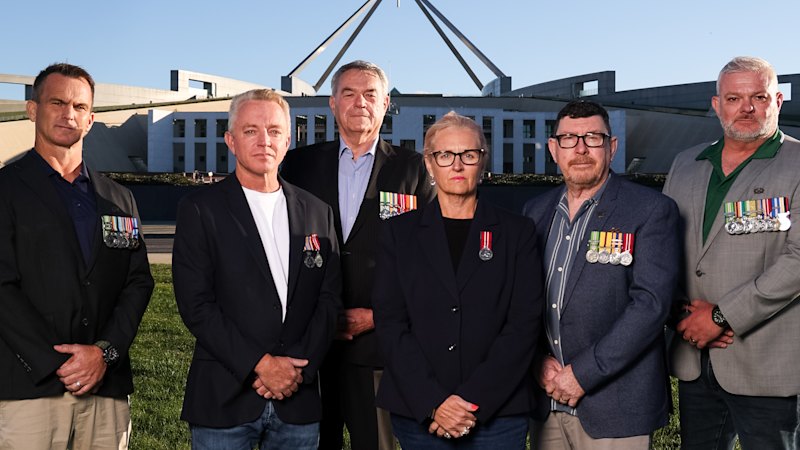
Veterans will lay down their service medals outside Parliament House on Monday morning in an extraordinary escalation of their campaign against the Albanese government’s changes to veterans’ healthcare.
The provocative ceremony will mark two years since the Royal Commission into Defence and Veteran Suicide delivered its final report, with veterans accusing the government of failing to honour commitments made in response to the inquiry.
The Coalition of Veterans’ Voices, comprising seven organisation and several high-profile advocates, is demanding the government abandon plans for a $5000 annual cap on allied health treatment, end what it describes as “low-balling” in the veterans’ health system and establish an independent inquiry into the handling of claims by the Department of Veterans’ Affairs.
Advertisement
John Armfield, a former Royal Australian Navy clearance diver who served for 20 years and completed five deployments, will speak at the ceremony at 7am in Canberra, where they will lay down their medals before meetings with Veterans’ Affairs Minister Matt Keogh and Prime Minister Anthony Albanese.
“These medals were hard won. Each represents deeds of valour and sacrifice gladly rendered in the service of the country we love,” Armfield said. “Yet with its deeds, our government is telling us our service was worth nothing. The recognition we received was conditional. Our covenant with our country one-sided.”
Armfield, who founded the Australian Investigation Agency after leaving the ADF, has campaigned for answers over the death of his brother, former RAAF serviceman LAC Andrew Armfield.
“This week marks two years since the Royal Commission into Defence and Veteran Suicide handed its final report to the Governor-General,” he said. “It found, in plain terms, that this country has not been keeping its promise to veterans.”
The coalition says the government accepted the royal commission’s recommendations, apart from a small number requiring further work, but argues the experience of veterans has not materially improved. It has also pointed to DVA processing delays as evidence of a system under strain.
Advertisement
The most immediate dispute is over the government’s decision in the May budget to introduce a $5000 annual threshold for allied health services, including psychology, physiotherapy, occupational therapy and rehabilitation.
Veterans say they were not properly consulted before the measure was announced and fear the limit will disrupt treatment for people with serious and complex injuries.
The government said it was investing $169.7 million to improve Veteran Card holders’ access to allied health services, with new funding arrangements to begin on July 1 next year.
The changes will scrap the current 12-session treatment cycle and introduce a $5000 annual threshold for treatment reviews while allowing veterans with clinically necessary needs to continue receiving care above the threshold.
Advertisement
The government has since opened a consultation on the measure, which veterans argue came months after the budget announcement and does not address their central demand to remove the limit.
The coalition says the government should instead guarantee veterans access to the treatment they need, with scrapping the cap the first of three demands.
The second is an end to what the group calls “low-balling” – a demand for veterans to have a genuine choice of accredited healthcare provider without being disadvantaged or having claims delayed if they choose a practitioner outside government-linked arrangements.
Its third demand is for an independent inquiry into DVA claims processing, including transparent and enforceable performance standards.
The campaign intensified in August, when the coalition held 32 meetings with members of the government, opposition and crossbench.
Advertisement
Keogh initially declined to meet the delegation before subsequently holding talks with the group. The dispute also spilled into parliament, including a censure motion and exchanges during question time which heaped political pressure on the Albanese government.
Women Veterans Network Australia president Melanie Annand said the $5000 cap was another barrier between veterans and the healthcare they need.
“Introducing these changes without meaningful consultation with veterans or health providers is not veteran-centred, not trauma-informed and risks making an already complex system even harder to navigate.”
Zoe Cullen, co-founder of PTSD Resurrected, said these were the kind of decisions that could push already vulnerable veterans closer to the edge.
Advertisement
“Families know what that looks like, and we should never accept policies that risk putting more veterans in the grave,” she said.
But several other groups, including RSL Australia and Legacy, thanked the government for addressing some of the key concerns raised in consultation paper released on August 31.
RSL national president Peter Tinley said the sector was being heard and that clinical need, not a dollar figure, was the right measure of care.
“The most vulnerable veterans are out of it entirely. The treatment cycle is gone. A veteran’s GP stays in charge of every veteran’s allied health care. That’s real movement and we acknowledge it,” Tinley said.
Cut through the noise of federal politics with news, views and expert analysis. Subscribers can sign up to our weekly Inside Politics newsletter.
Lifeline: 13 11 14
You have reached your maximum number of saved items.
Remove items from your saved list to add more.
More:
Rob Harris is the national correspondent for The Sydney Morning Herald and The Age based in Canberra. He is a former Europe correspondent.Connect via email.AdvertisementAdvertisement