
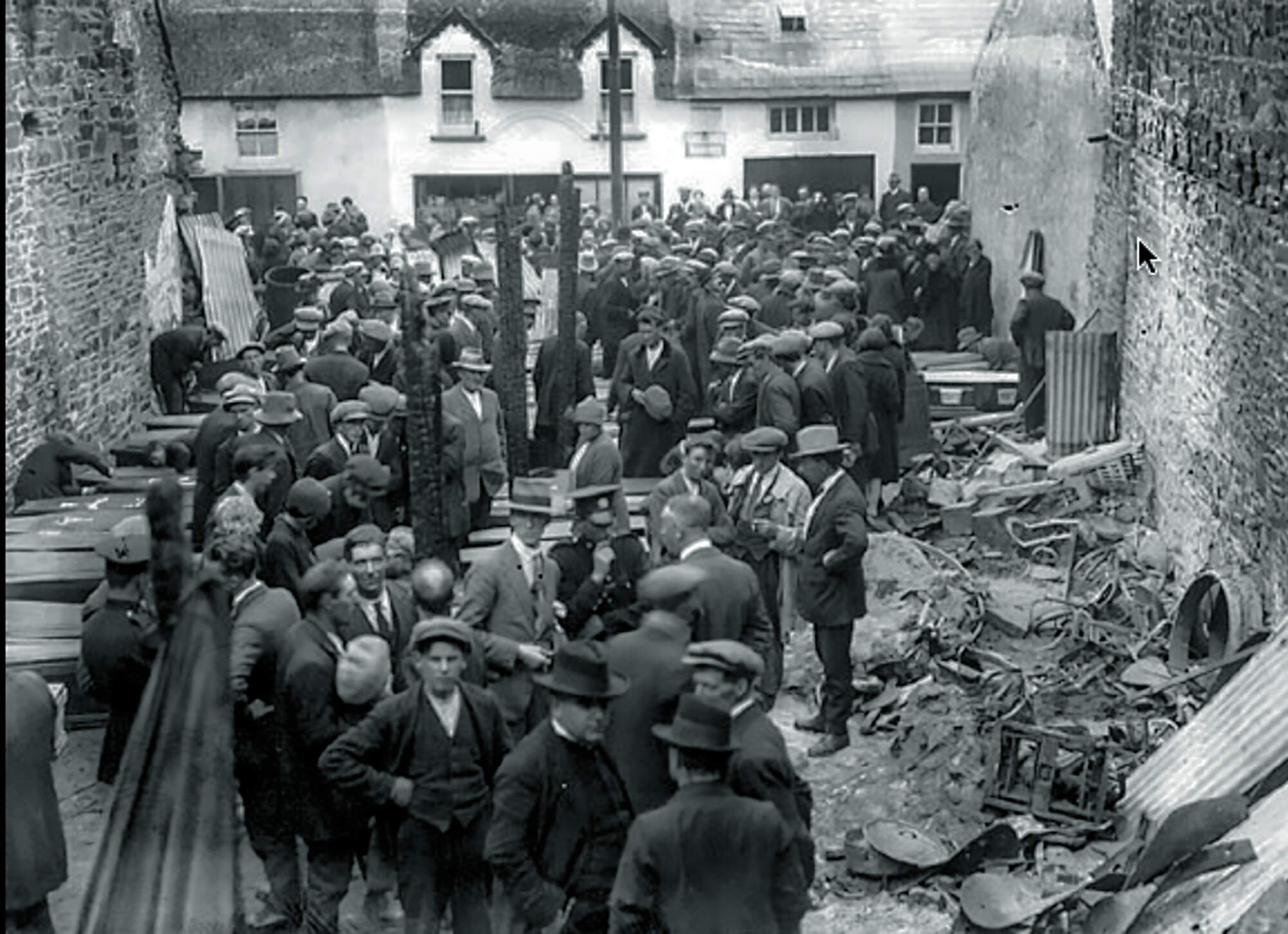
“An entire parish community was traumatised in the horror of that dreadful night,” Bishop John Fleming told the Centenary Mass for the 48 men, women and children who died in the Dromcollogher Cinema Fire of 1926.
Marking one of the deadliest tragedies in modern Irish history, Dr Fleming, a native of Ardpatrick in Co Limerick, told those gathered in Dromcollogher for the memorial mass, “The fire affected every family in this community.”
Recalling the enormous scale of the tragedy, he highlighted that a century ago Dromcollogher had a population of just 500, meaning approximately one in ten members of the west Limerick community died in the fire. One entire family was lost, while several other families suffered multiple bereavements. The victims ranged in age from seven to 68 years of age.
The effects extended far beyond the 48 lives lost, it impacted families for generations, Dr Fleming said.
“An entire parish community was traumatised in the horror of that dreadful night. The one hundred years which have followed the tragedy have also seen the lives of many individuals and families, in varying degrees, deeply impacted by the events of that night,” he said.
The Centenary commemorations of the tragedy known locally as ‘The Burning’ also included the planting of 48 Irish oak trees, one for each of those who died in the fire.
Bishop Fleming said the trees would provide a living memorial to those whose lives were lost and allow their memory to make a contribution to future generations.
“The planting of 48 Irish oak trees in memory of the victims of the fire will ensure that even in death the victims of this tragedy will make their contribution to resisting climate change for the world of the present and the future,” he said. “They will continue to influence our future by their presence in nature.”
The Taoiseach Micheál Martin and the Minister for Culture, Communications and Sport Patrick O’Donovan officiated at a formal state ceremony in Dromcollogher on Saturday to honour the victims.
They laid wreaths at the mass grave where victims were laid to rest. The names of each of those who perished in the fire was recited by Master of Ceremonies, Bryan Dobson. The Taoiseach also unveiled a commemorative plaque and planted a tree, assisted by children from Scoil Naomh Iosef.
Speaking at the event, Mr Martin said, “There is an important lesson to take from the disaster, I believe, and that is on the fragility and preciousness of life. The fire was a terrible accident, with a candle knocked over in the worst possible place. It could have happened at any similar gathering at that time.”
Minister O’Donovan said, “The loss from the events of 5th September 1926 has resonated for decades beyond 1926. It is not a thing of history, forgotten and resigned to irrelevance and dust. No, it is a thing of today, it lives among us still.”
Referring to the fact that what occurred and what was witnessed was “seldom spoken of” by the community, the Mayor of Limerick, John Moran noted that, “In recent times, that has changed. The community choir and ‘Finding our Voice’, part of the Dromcollogher Centenary Commemorative Programme, have given local people a way to express that loss —something their grandparents and great-grandparents could scarcely face.”
On the night of Sunday September 5, 1926, two films were scheduled to be shown at the makeshift cinema in the upstairs loft area of a store belonging to a local hardware shop in Dromcollogher. The main film ‘The Decoy’ was to follow a short film called ‘False Alarm’. Around 150 people had gathered to watch the films, many of them having earlier attended Sunday night Benediction in the local Church.
The fire was caused by a falling candle during the showing of the second film at ten minutes to ten o’clock. The candle fell onto the highly flammable nitrate film reels which caused the fire to spread rapidly. With limited exits and a number of the windows barred many people were quickly trapped and overcome by fumes.
Forty-six people died that night which was determined by a count of skulls. Two more died in the following days. Most of the bodies were found in the corner under that part of the hall that served as the dressing room. All the remains were placed in coffins and buried together in a mass grave in the grounds of the local church.
At Mass on Saturday, Dr Fleming said the absence of the counselling and trauma supports available today made the suffering even more difficult for survivors and the local people to process, contributing to a silence that descended on the community.
While an investigation into the cause of the fire began immediately, Bishop Fleming said one of the most striking aspects of Dromcollogher’s story was that the people of the small Co Limerick village did not allow blame and recrimination to divide them but they sowed the seeds of a resilient community built on forgiveness, understanding and care for one another.
“It is to the credit of this community that the culture of finger-pointing and blame never became a destructive reality among you,” he said. “Feelings were not buried but forgiveness and understanding gradually began to take hold, and the seeds of a resilient community were sown. While the reality of the tragedy never went away, a healthy future began to emerge.”
Acknowledging that memories and perspectives on any tragedy will differ he said the story of the century since the fire demonstrates that community togetherness and resilience ultimately triumphed.
That resilience was evident, he said, in the decision within 14 years of the tragedy to build a new community hall. And despite the deadly blaze this hall included a cinema. ”A less resilient community than yours would never have considered a cinema within such a short time,” the bishop said.
This community spirit, he noted, subsequently found expression in initiatives including the Dromcollogher Respite Care Centre and the Dromcollogher Community Housing Association.
Bishop Fleming said the centenary inevitably brings people back to one of the most difficult questions raised by human suffering: Why?
“Why does God allow innocent people, even children, to suffer? Why did He allow this tragedy to take place?” he asked.
For Christians, he said, there can be no easy or simplistic answer to the problem of suffering and evil. “The problem of evil cannot be answered simply. It is a mystery,” Bishop Fleming said.