
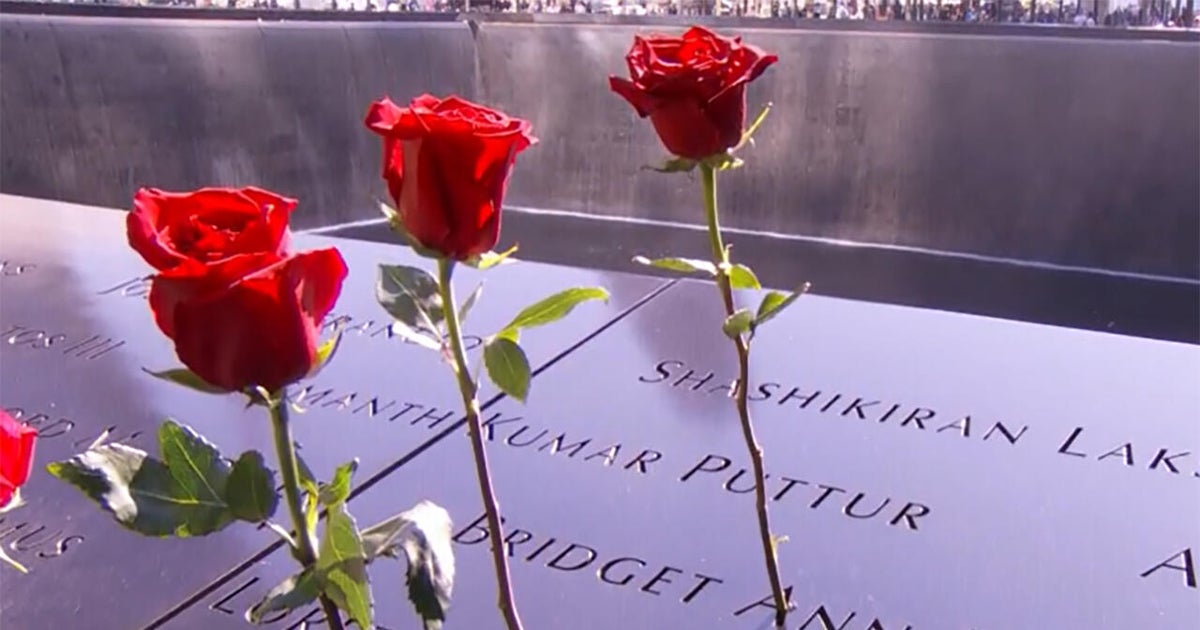
There’s a fine line between “never forgetting” 9/11, and “always reminding.” Too much is distasteful, too little is disrespectful.
You might think after all this time, there’s no bell left un-rung, no prayer unsaid, no song that hasn’t been sung. After 25 years, the most fitting way we can think of to keep the day close is talking to those who were there.
Ground Zero
“You could see flames shooting out of, you know, all sides of the North Tower,” said Harry Handler, who was on the 67th floor of the other tower, 2 World Trade Center. “The building made an announcement that said, ‘There’s been an incident in 1 World Trade Center. If you’re in 2 World Trade Center, return to your desks.’ I thought, this is just a bad idea.”
Seventeen minutes later, a second plane hit his tower. He began leaping down flights of stairs, 12 steps at a time.
And then he stopped. “I ran into a woman who was leaning against the bannister having an asthma attack,” Handler said. “I said, ‘Well, let me take you down.’ She took my arm. Even though she was breathing heavily, we went very slowly down the stairs.”
They had no idea that a third plane had hit the Pentagon.
The Pentagon
“Things were not where you’d expect them to be,” said Marine Major Dan Pantaleo, who rushed in to help, though no one had asked him to. “There was a part of a desk that was sort of in the ceiling. There was what looked like a safe that was turned sideways and embedded into the wall.”
Rural Pennsylvania
Just a half an hour later, the last of the planes, likely headed to Washington, too, crashed into a field in Shanksville, Pennsylvania. Passengers, having gotten word of the attack on both New York and the Pentagon, had stormed the cockpit.
“On that dark day, 40 people did something that gave America hope,” said Tim Lambert. “They’re faced with the worst thing, and they voted to do something about it, and they did.”
Lambert’s family had owned the land where United Flight 93 went down since the 1930s.
“Those trees took the brunt of the explosion,” he said. “And then, over time, we saw Nature start to take hold again. Grass was growing, wildlife was coming back. But the reminders of what happened there were always constant.”
One of the names on the Flight 93 Memorial is First Officer LeRoy Homer Jr. His only daughter, Laurel, was 10 months old. “I feel like it’s something I struggle with a lot still,” Laurel told us. “It’s like what my life was supposed to be, versus what it ended up being, and just not even knowing who I would have been.”
Over time, she attended summer camps organized for survivors, but after 25 years, those camp-goers are now all adults.
“I kind of grew up with a level of shame to the whole thing, and I was bullied at points for it,” Homer said. “This girl, like, wrote ‘DD’ on a paper, and she was like, what does that stand for? And then she said, ‘Dead Dad.’ And then ever since then, I don’t think I really had a great place to grieve in a healthy way.”
Each sees these annual 9/11 observances a little differently.
“They’re all tough,” said Handler. “Sometimes I don’t sleep well, and think, ‘Oh right, it’s September. People are thinking about it again.'”
Pantaleo said, “There’s a flood of emotions. I remember things like all of the American flags on people’s houses just popping up all over the place. So, I go back to that, and I’m hopeful, but then I also recall the incredible devastation and destruction, and that’s a different experience for me.”
For four days, Pantaleo recovered more than a hundred sets of remains from the still-smoldering Pentagon. But he also recovered a bit of light: a scarlet-and-gold Marine Corps flag that, remarkably, was still standing upright, teetering on the edge of the scar. “It was just incredible to see it up there on the fourth floor, pristine, untouched, unfazed by all the destruction around it,” Pantaleo said. “It felt like we just couldn’t let that flag be another victim.”
In the midst of the chaos, Pantaleo soon found himself on a lift inching up to get the flag still wreaking of jet fuel. He brought it down to safety, much the way Harry Handler brought that stranger down from Tower 2 in New York.
“I took her to an ambulance and I said I’ll stay with you,” Handler recalled. “I had gotten her all the way out of the building, and they said, ‘No, you have to leave.'”
Minutes later, Tower 2 collapsed right on top of the ambulance where he left the woman he hoped he’d saved.
“I thought, I need to find her family,” Handler said. “There was an event that the firm had, it was like a happy-to-be-alive event a few weeks later, and I was explaining that I was looking for this woman’s family. And they said, ‘She’s right over there.'”
Her name is Vonnie Johnson. Handler says he got an email from Johnson every September 11th, until about ten years ago, when the emails stopped. “I looked around, you know, and searched and tried to find out what happened to her, but I never did.”
We didn’t find her, either. After all, 25 years is a long time.
As the years passed, the difficult but healing task of designing and building fitting memorials crept along.
Tim Lambert ended up donating part of his property in Shanksville, Pa., back to the Flight 93 families. “One of the things that I had vowed was to never take money for those six acres that were part of the crash site,” he said.
As for that flag rescued from the Pentagon, it now sits in a place of honor, at the National Museum of the Marine Corps in Virginia. “I think it became a symbol of our resilience, our refusal to quit,” Pantaleo said. “The idea behind, we’re not going anywhere, we’re standing tall, we’re standing strong, and all this devastation, we’re gonna still step forward and respond to this.”
That response lasted for the next 20 years. More than 7,000 U.S. service men and women were killed in Iraq and Afghanistan. The cost to U.S. taxpayers was in the trillions.
Laurel Homer paid her own price: “I’ll probably be in therapy for the rest of my life still about this,” she said. “I started therapy when I was three about this, so I’ll have good days and stuff, but I don’t even know that I’ve ever been fully happy, and I feel like, even on the days that I’m supposed to be the happiest, I still am thinking about who I’ve lost and what I don’t have.”
Asked if he believes 9/11 gets the remembrance it deserves, Pantaleo replied, “Probably not, probably not, because we’re so focused on what happens right now, today. And I think sometimes we forget to look back.”
For many survivors, this 25th anniversary is really no different than the first, the 10th, or the 20th. Truth is, the story of 9/11 is still being written.
“It has been almost 25 years,” said Homer. “Maybe I need to move forward a bit more. But it’s still really hard, so I don’t know, I really don’t know.”
Remembering 9/11: Andrew Card on the moment everything changed
Remembering 9/11: Robert De Niro on helping revive Lower Manhattan after September 11
Remembering 9/11: When Gander provided safe haven in a time of crisis
Remembering 9/11: “Come From Away”: Transforming tragedy into art, darkness into light
Remembering 9/11: 9/11 changed the U.S.; Can we change back?
For more info:
- 9/11 Memorial & Museum, New York City
- The National 9/11 Pentagon Memorial, Arlington, Va.
- Flight 93 National Memorial, Shanksville, Pa.
- RedVector.com Pentagon footage: RedVector.com, LLC. Copyright © 2001. William G. DeWeese – Camera 1, Jude Rothschadl Coke – Producer/Camera 2, Christopher DeWolf – Advisor
Story produced by Mark Hudspeth. Editor: Remington Korper.
In: