
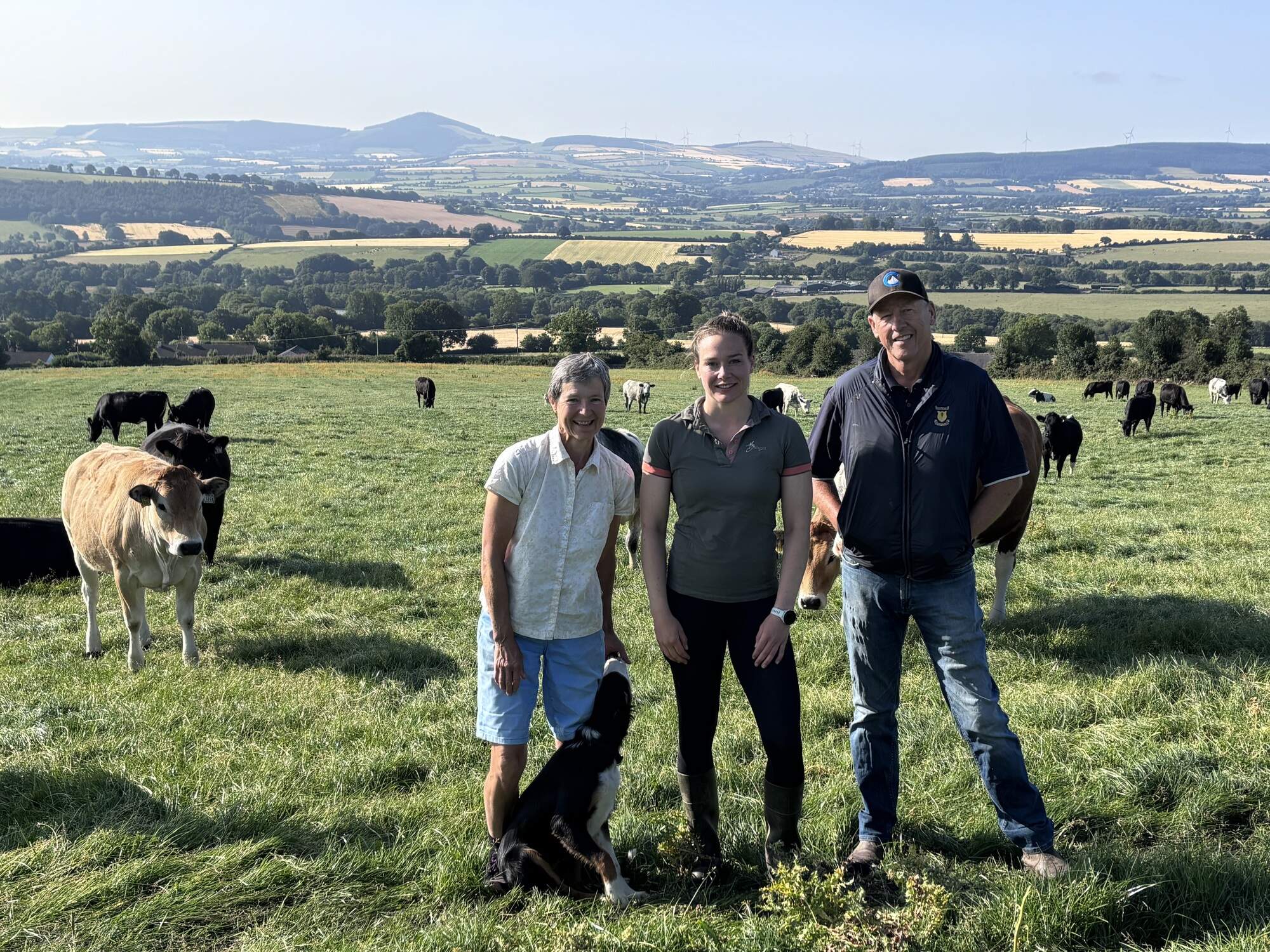
Succession can be one of the most difficult conversations farming families face, but for Colin and Janet Tyner it has become a roadmap for the future of their four-generation farm outside Shillelagh, Co. Wicklow.
Having agreed a long-term plan with their three children, and formally brought daughter Sophie into the business, the family will open their farm during Teagasc’s Farm Generational Renewal Week to demonstrate how a carefully managed transition can support both the incoming and outgoing generations.
Originally purchased by John Tyner, the 120-hectare farm is now owned by Colin and Janet Tyner and is run as a mixed enterprise of beef, sheep and tillage; grain is retained for home feeding and all progeny are brought to slaughter.
Colin grew up on the farm and worked alongside his father until marrying Janet in 1985 at age 24.
At that time, half the farm was transferred to Colin and Janet as a lifetime gift, while Colin’s parents retained the other half, each holding a one-quarter share.
The land was held as tenants in common, meaning each person owned a distinct share that would pass by will, rather than by survivorship.
Colin recalls that before the transfer his father still called the shots. However, on the first day after the handover his father asked: “You are in charge now, what are we doing today?”
Colin’s father continued to work on the farm, providing support and advice, but allowed Colin and Janet to take management decisions.
The couple have three children. While Meghan, the eldest, is a teacher with a family, and Craig works in information technology, Sophie always had an interest in agriculture, graduating with a degree in agricultural science from UCD in 2016.
With Sophie working away in 2018, Colin and Janet were uncertain whether any family member would farm the land, so they simplified the system to reduce workload.
This meant the suckler herd was significantly reduced, and the sheep enterprise was largely wound down.
Following the deaths of Colin’s parents, their shares passed to Colin: his father’s quarter first, and his mother Irene’s quarter on her death in 2021, leaving Colin as sole legal owner.
Sophie returned to Wicklow in 2023 to work for Grassland Agro and now leads a team of five advisors providing nutrient management advice to farmers.
She has also taken on a major operational role on the family farm. Over time the family discussed the long-term future and agreed Sophie would be the farming successor.
Colin and Janet are fortunate to have other assets to pass to Meghan and Craig, meaning all three children will inherit, though not necessarily equally. The siblings, the family says, get on remarkably well.
To formalise succession and access supports, Colin, Janet and Sophie formed a registered farm partnership (RFP) and a succession farm partnership in January 2025.
The RFP enabled Sophie, as a young trained farmer, to qualify for complementary income support for young farmers, worth close to €8,000 per year for up to five years, as the farm exceeds 50ha.
The partnership also raised their TAMS (Targeted Agricultural Modernisation Scheme) ceiling to €160,000—compared with €90,000 as a sole trader—with the first €90,000 eligible at the 60pc rate because Sophie meets the young farmer criteria.
Their succession plan requires transfer of 80pc of farming assets to Sophie before the end of the 10th year of the plan.
In return, the partnership receives a €5,000 per year tax credit, divided according to the partnership’s profit-sharing ratio. This credit can be applied against farming and off-farm income, which benefits Sophie as she combines farm work with off-farm employment.
With succession arrangements in place, and Sophie and her partner Daryl involved in long-term planning, the Tyners have adjusted their farming system again.
The sheep enterprise has been re-established with 100 lowland ewes lambed this year.
Some calves are contract-reared under the Buitelaar programme, allowing the farm to increase livestock numbers without the upfront cost of purchasing animals—an attractive option for those starting out.
The family used TAMS funding in 2025 to invest in a new cattle crush, sheep weighing and handling facilities, and a GPS-controlled fertiliser spreader, prioritising labour efficiency and farm safety.
Community and charitable activity are part of the farm’s identity too. During the Covid period they grew sunflowers and invited people to pick them free of charge in return for donations to a charity box, with proceeds going to the Irish Cancer Society, Wicklow Hospice and other local causes.
In 2026 they ran another pick-your-own sunflower event over the August bank holiday with donations again directed to local charities.
On Friday, September 11 they will again open their farm to the public, this time to show what they have done to bring the next generation into the business.
Beginning at 6pm, the family walk will demonstrate these practical and governance changes in action, and provide other farming families with an example of how collaborative models and careful planning can enable generational renewal.
Long-term, the plan is to transfer the land to Sophie under the succession plan, with Colin and Janet remaining active in the farm’s activities through the RFP structure—mirroring the way Colin’s father stayed involved after handing over day-to-day control.