
Advertisement
You have reached your maximum number of saved items.
Remove items from your saved list to add more.
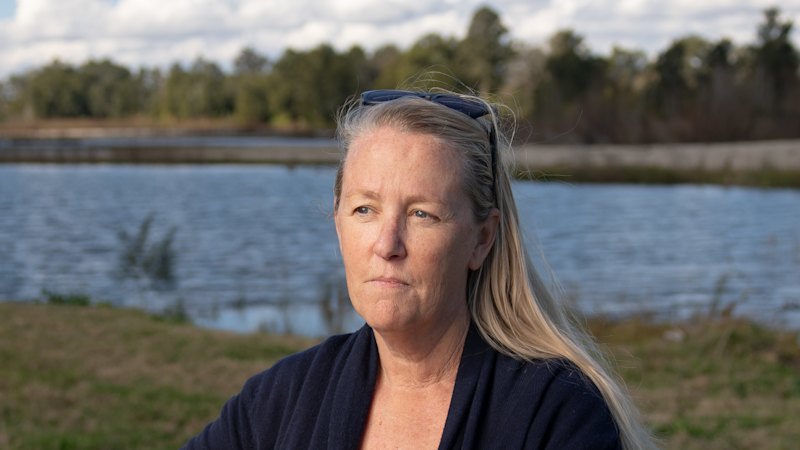
Megan Vicary is among the growing ranks of Australians who do not carry full home insurance.
The 52-year-old moved to her 10-hectare property in Yarramundi in the Hawkesbury region nine years ago and had an insurance policy that cost her about $6000 a year. After four floods in 2022, it went up to $35,000 a year, and she could no longer justify the expense.
Now, the quotes are as high as $50,000 a year, and many insurers won’t offer flood coverage at all, based on her postcode. She still has a policy, but it doesn’t cover flood.
“No one’s insuring for flood,” Vicary says. “If we have a major flood, it is going to be a crisis because none of us can afford it. All the way down the riverbank, none of us are flood-covered.”
The same crisis is playing out nationally as mounting climate disasters drive up insurance risk, and consumers drop their coverage, preferring to self insure or hope for a government bailout. As the United Nations reports that the goal of curbing global warming to 1.5 degrees has failed, the task of climate adaptation grows more important. Insurance is at the heart of the challenge.
Across Australia, the regions with the highest insurance premiums are those with the most flood risk, and this is particularly true on the east coast, according to analysis prepared exclusively for this masthead by actuarial firm Finity. Bushfires are a factor, too, but flood is the overwhelming driver.
Advertisement
The most expensive insurance on the east coast is in the Richmond-Tweed region in the NSW Northern Rivers, when comparing large sub-state regions defined by the Australian Bureau of Statistics as statistical area 4 (SA4).
In Richmond-Tweed, near the Queensland border, premiums have risen 81 per cent since January 2021. The average quote for a new policy in the region, which includes Lismore, Tweed Heads, Murwillumbah, Byron Bay and Ballina, is now $8836 a year.
The most expensive insurance in Victoria by SA4 is in the Shepparton region, where the average quote is $4871 a year, up 77 per cent. The highest in Queensland is in the west of Brisbane, where home owners now pay an average of $6173, up 74 per cent.
What all three regions have in common is that they were hit by devastating floods, sometimes numerous times, over the past decade, and most especially in 2022. NSW premiums are particularly high because they include the emergency services levy of between 15 and 18 per cent, which is not funded through insurance in other states. The NSW government is considering reforms.
Premiums in the Cairns SA4 region have gone down over the past five years and are now an average $3985 a year. Finity principal Stephen Lau says this is because the federal government created a cyclone reinsurance pool in northern Australia to make insurance more affordable in cyclone-prone areas. The program is monitored by the Australian Competition and Consumer Commission.
Advertisement
In some locations, it is possible to zoom in even closer to clusters of individual suburbs. Breaking down the Blue Mountains and Outer West sub-state region into three SA3 sub-regions reveals that the Richmond-Windsor area – where Yarramundi is located – has average premiums of $12,606 a year, a rise of 91 per cent over five years. Again, the main reason is flood risk.
But in Victoria, the most expensive of these smaller regions is the Yarra Ranges, east of Melbourne, which has an average premium of $5183 a year, an 81 per cent rise mainly because of fire risk.
Analysis used by the Insurance Council of Australia suggests the most vulnerable people and communities in Australia have the highest flood risk but the lowest financial and social capacity to protect their properties and families and to recover from disaster.
Council chief executive Andrew Hall is hugely concerned by this trend.
“When the worst happens to them, and most of the time I’m talking flooding, they just go backwards, and [that] creates this intergenerational cycle of poverty because they’re caught in a trap that they can’t get out of,” Hall says.
“They can’t sell their home [because] no one buys it back. It gets rebuilt in the location it was in, or they’ve just got no money and they’re stuck trying to put together what they’ve got left. That is the big picture.”
Advertisement
About 1.4 million properties nationally face some risk of flooding, including almost 300,000 properties that face a severe-to-extreme annual flooding risk, largely in NSW, Queensland and Victoria, the Insurance Council says.
The cost of dealing with natural disasters without insurance is high.
Vicary’s home was built in the past nine years and sits about five metres above what is commonly referred to as the one-in-100-year flood line – though more accurately, that means there is a 1 per cent chance of flooding in any given year. The water has never risen as high as her house, but the clean-up is still a big task.
“Even if you don’t get floodwater in your home, when that river comes up, you’ve got all the animals that come out of everywhere – the mice, the snakes, the bugs,” Vicary says. “Mildew starts to grow in your house – I literally for weeks had to turn my air-conditioner on to get the humidity out of my house, so I didn’t have mould growing.”
Her lower paddocks front the river, so she has to evacuate animals – including alpacas, sheep and horses – and then clean up for their safe return. She has spent $65,000 of her savings on replacing fences, cleaning out low-lying sheds and disposing of the debris dumped by the river, including a washing machine and half a speedboat.
Advertisement
Australia remains a relatively well-insured nation, but the protection gap is growing. The Insurance Council’s Alix Pearce wrote in a Churchill fellowship report titled Insuring Australia Tomorrow in January that, of Australia’s $US37 billion ($51.7 billion) in losses from extreme weather over the past decade, $US12 billion, or about a third, was not insured.
Between 1987 and 2015, the number of properties exposed to high flood risk increased by more than 65 per cent both because of more homes being built and also climate change increasing the physical risk.
The average cost to build a new house in Australia has risen by 30 per cent since 2021, faster than the cumulative inflation rate of 24 per cent over the same time frame, the Insurance Council reported this week.
When damaged properties are repaired under insurance, they are held to outdated building standards, which means they will not be resilient to worsening weather. People who can afford it are taking matters into their own hands and disaster-proofing their homes.
Building back better
Sarah Thomson, 53, and Bec Nicoll, 56, moved into their newly rebuilt home in Kialla, near Shepparton, a week ago, more than four years after they were flooded by Seven Creeks, a tributary of the Murray.
Advertisement
They are relieved and delighted, after first living in a caravan for nine months and then in a 36-square-metre shed for more than three years. They have built back better, putting in about $500,000 of their own money on top of the insurance payout.
First, they had to battle with their insurance company, Allianz, for 12 months to be allowed to demolish and rebuild. “They said that it was repairable, but the slab was still wet after nearly 12 months, and we didn’t want to be putting floorboards on top of a wet slab,” Thomson says. “Negotiating with the insurer was a long, tedious, irritating process. That’s not available to a lot of people. We’ve got the ability to actually negotiate and to be able to fight for a good outcome.”
Nicoll says Emergency Recovery Victoria provided teams of engineers and hygienists who recommended demolition, but Allianz “completely disregarded” the report as too generic. Eventually, the couple engaged a private engineer and researched insurance law to force the issue.
Allianz chief claims officer Luke Whenman apologised if Thomson and Nicoll had had a bad experience. He said the company always looked for the best way to build back within the funding envelope, and that it could provide an extra $20,000 to boost resilience. Cash settlement was not a good option for most customers because they would be unable to find tradespeople after a disaster, he said.
Thomson and Nicoll’s new house is raised on stumps and is also on a hillside, making it 1.25 metres higher than their old home and above the one-in-100-year flood level, with a buffer for climate change. They have also adhered to Passivhaus principles for temperature control and relevant bushfire codes.
None of this has made a difference to their new insurance premiums. Before the flood, they were paying between $2000 and $2500. They have now found insurance for $6100 a year, having fielded some quotes as high as $18,000 a year.
When shopping around, the couple found there was nowhere to disclose any of the resilience features of their new home. “When I said to a sales agent that we’ve actually rebuilt well above the mandated height for flooding in our area, he said, ‘that’s nice, I’m happy for you, but that doesn’t alter the policy’,” Nicoll says.
It was a similar story for home owners in northern NSW who flood-proofed their dwellings after being inundated in 2022. Virginia Jones and her husband, Tim Lawson, in Bogangar, near Cabarita Beach, put their home on stilts, raising it so high that a full-size netball hoop stand could fit underneath. Their next-door neighbour Bernie Zietlow rebuilt his home with materials that mean it could be hosed out after a flood.
Jones says her insurance premiums have more than doubled to about $6000 a year, despite the lower flood risk because of raising the property. Zietlow’s insurance premiums have gone up from $1000 to $4000 a year for a small home. He has priced insurance with and without the improvements, and it made no difference.
This is a problem that the Housing Resilience Action Plan aims to solve. A collaboration between Finity, the Resilient Building Council, Monash University and consumer advocacy groups, the proposal is to develop a rating system for every home in Australia that insurers use when pricing premiums.
Finity principal Sharanjit Paddam says the rating for each type of natural disaster would incorporate the risk profile of the area and the resilience of the actual home. “The idea … is to have a common language, so that consumers understand what the resilience of their home is to different disasters, insurers use that information to price insurance contracts, and then banks lend people money so that they can get the house to a different resilience level,” Paddam says.
“When you get your renewal notice, they’ll say, ‘OK, you are three-star-rated against flood, and that has led to this pricing for your insurance premium, but if you were four-star-rated, this is what your premium would be’. Including signals like that can empower consumers to make decisions.”
Lowering community risk
Scott Hawkins, managing director for Australasia at global reinsurance company Munich RE, says lowering the risk of events that occur every three to five years won’t significantly reduce premiums. It’s mitigating the risk of more extreme events that occur every few decades that would make the difference, he says.
“Some things people can do at the home level, but some things need to be done at the community level,” Hawkins says.
The Insurance Council has called for a 10-year, $30 billion flood defence fund to bolster infrastructure in 24 priority catchments nationally. The catchments were chosen because of flood risk and insurance affordability pressure. They are all in the eastern states.
Hall says the government has the right idea with the Hazards Insurance Partnership, which is designed to fund community and household infrastructure that can reduce risk and put downward pressure on premiums.
That is world-leading, Hall says, because the government persuaded insurance companies to provide information into the program, whereas in other developed jurisdictions such as the United States, governments had to sue to get access to the commercially sensitive data.
The government also created the Disaster Ready Fund, which was $200 million a year, though it has recently been reduced to $142.4 million.
“Again, huge tick, very smart idea,” Hall says. “The problem with it is that … so far… they’re programs like teaching people about bushfire awareness or building cyclone shelters.”
Hall says there would be more downward pressure on premiums if the money were spent on hard infrastructure and community-level defences, such as flood levees.
With Gay Alcorn
Get to the heart of what’s happening with climate change and the environment. Sign up for our fortnightly Environment newsletter.
CLARIFICATION
The story has been amended to clarify river references. The Shepparton SA4 state sub-region stretches north to the Murray River but also includes the Goulburn and Broken Rivers and other waterways in the Murray-Darling Basin.