
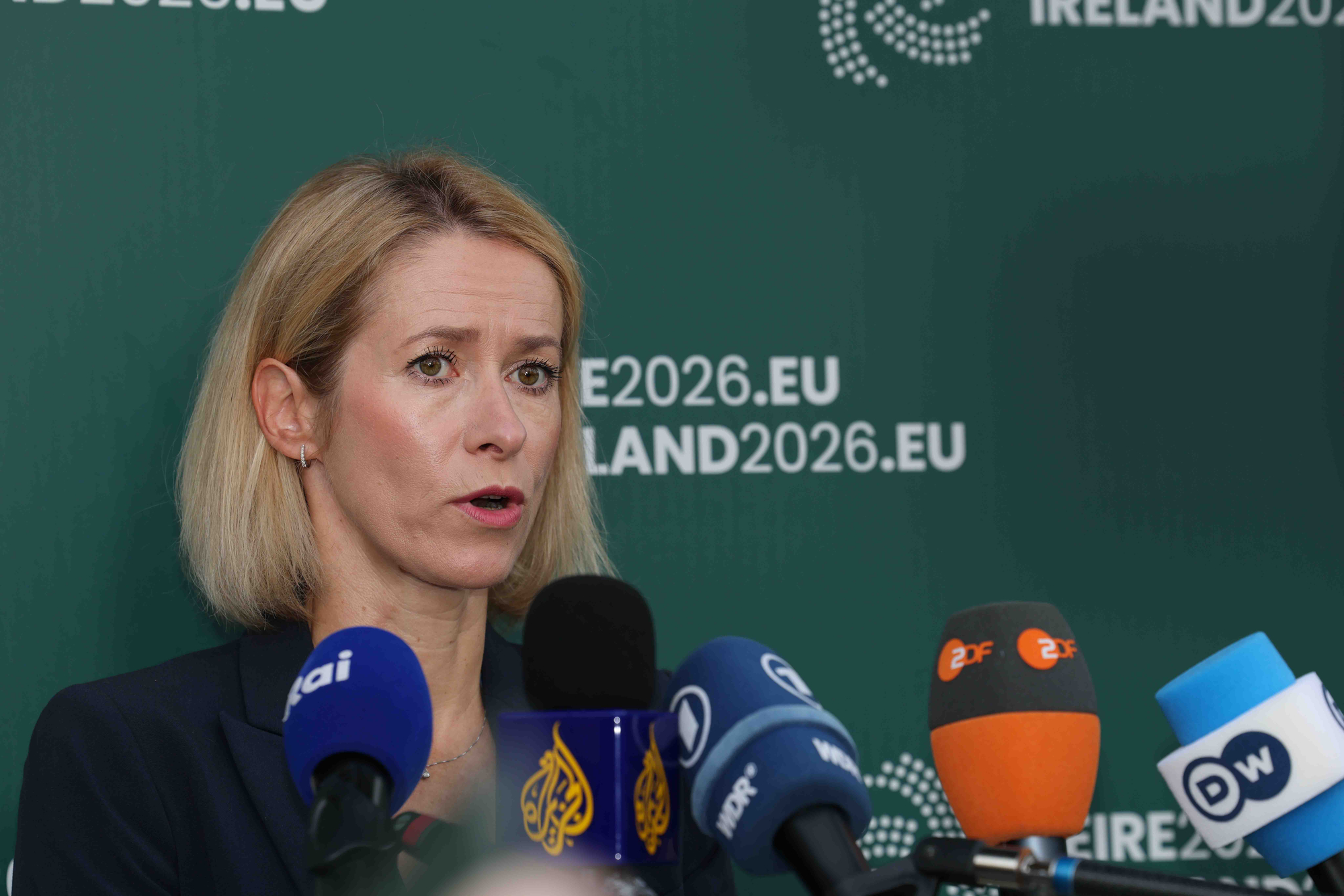
Kaja Kallas said the body will convene the ‘brightest minds’ from EU, UK and Ukraine in bid to plug Nato defence gaps
The European Union’s chief diplomat has unveiled plans for a high-level group made up of senior political and military leaders to help plug gaps within the bloc’s security during a meeting in Co Wicklow.
EU defence ministers met to discuss the ongoing war in Ukraine as well as maritime and space security issues.
The meeting included defence ministers from across the EU and senior representatives of the European institutions to discuss key issues for European security and defence.
There is an increased garda presence, road closures and airspace restrictions as Ireland hosts the presidency of the European Council.
Kaja Kallas, the high representative of the union for foreign affairs and security policy and vice-president of the European Commission, chaired the meeting.
Speaking at Druids Glen resort, Ms Kallas said the new high-level body, which will be launched next week, will include some of the “brightest minds” on security and defence from the EU as well as the UK and Ukraine.
Ms Kallas said: “Next week I will launch a new high-level group on defence consisting of senior political and military leaders from several EU countries but also from the UK and Ukraine.
“Europe is investing more in defence than ever but spending alone is not automatically a guarantee for success.
“We have not been fast enough to cover the gaps in Europe’s conventional power within Nato that we have identified.
“The aim is to have some of the brightest minds on security and defence to come together and really provide out-of-the-box solutions.
“How can we be faster to fulfilling these gaps and how can we be more effective, especially now that security threats in Europe are so much more real.
“Under my auspices the group will bring its findings together in a report setting out concrete recommendations for Europe’s defence.”
She said that the majority of EU member states are also members of Nato, and that there are gaps in convention of power in Nato.
“That means that EU states need to invest in those capabilities and those things need to work together,” Ms Kallas added.
“We have not been fast enough, though the threat level is rising, so the idea is to look beyond institutions but to have the brightest minds come together to provide ideas on how we can fulfil the gaps on the shortest time frame possible in the most effective way.
“It is to give ideas to EU member states and institutions, what we should do better and faster.”
Ms Kallas said the names of those involved in the big-level group will be unveiled next week.
Meanwhile, Ireland’s Minister for Defence Helen McEntee said that while Ireland was previously lacking in its investment in defence, that has “now changed”.
“We increased our defence spending overall by 43% in the last few years, and as we get into Budget negotiations my ambition across Government is to increase that further,” the Fine Gael TD said.
“Irish people can see we are not talking about a conflict in Ukraine, we are not just talking about hybrid threats, we are talking about starting to see threats materialise only as recently as the last 24 hours.
“Our colleagues in Romania, Latvia, and Estonia have spoken of incursions into their own airspace but also in their own land domain.
“It is absolutely essential when talking about Ukraine, we remind people that we are talking about all of our security.”
Ms Kallas also said that Russia is “testing” the EU all the time, edging closer to its borders.
She said: “When it comes to Russia’s attacks that are increasing, it is clear that the risk is rising.
“It is necessary that we do the steps we need to do.
“That is why I called this group together to be able to respond to these types of attacks.
“We have to be ready to act on our words, otherwise our words are making us weaker because they know we are not acting on those words.
“I feel that Russia is testing us all the time, getting a bit further and that’s why we need to respond.”
The informal meeting on Tuesday addressed the EU’s support for Ukraine, including defence support, EU-Ukraine defence-industrial co-operation, the Ukraine Support Loan and mobilisation of the European Peace Facility.
Ukraine’s acting minister for defence Andrii Khmara and Nato deputy secretary general Radmila Shekerinska took part in the discussion.
Speaking ahead of the meeting, Ms McEntee said it is taking place during a “very uncertain” time for security and defence on a global scale.
“Unfortunately this summer, in particular in the month of July, we saw over 400 civilians killed in air strikes and attacks by Russia in Ukraine and we have seen over 2,600 casualties, so our continued unwavering support for Ukraine, politically, financially and militarily, will be to the forefront of discussions this morning,” she said.
“You will also see discussions continue with our foreign colleagues tomorrow.
“It is absolutely essential that we continue to support Ukraine at a time where financial support, particularly for air capabilities, is really essential but also coming into the winter months where we know that critical infrastructure is being targeted directly by Russia.”