
Advertisement
The mugger was holding a razor blade to my face.
It was 1992, my first summer in New York, and the two of us were standing in an elevator. I was marginally employed, having just graduated from college in the middle of a recession, meaning I didn’t have much to offer my assailant.
A look of disappointment crossed his face as he assessed my goods – a Seiko watch, $US7 ($9.75) in cash, a leather bag stuffed with magazines and tampons.
He took the watch and the money. Then he considered the banged-up Sony Walkman I held in my trembling hand.
Advertisement
“I mean, you can have it,” I said. “But I need the cassette inside.”
It was a 90-minute mixtape I had made to help me process some feelings over a break-up with a recent girlfriend. The song list – including Patti Smith’s Distant Fingers, Deee-Lite’s Love Is Everything and Dionne Warwick’s He’s Movin’ On – evoked the mood of a letter you write but never send.
I had put a lot of work into it, spending hours parked next to my roommate’s stereo system as I transferred the songs from the vinyl discs spinning on the turntable to the cassette in the tape deck.
With my right hand, I gently set the stylus down on the shiny band just before the grooves of each song I had chosen. Once the needle was in place, I used my left hand to release the pause button of the tape deck, which was set to record. In the analog days, this is what you had to go through to create a soundtrack of your inner turmoil.
So I had no choice but to take a stand with the mugger, now holding my Walkman. “You’re just going to throw the tape away,” I told him. “It’s probably too weird for you.”
Advertisement
“What’s on it?” he asked.
I mentioned a few artists. He winced.
Much to my relief, he hit the eject button, removed the cassette and handed it over. As he exited the elevator, he wished me a good weekend.
Home DJs
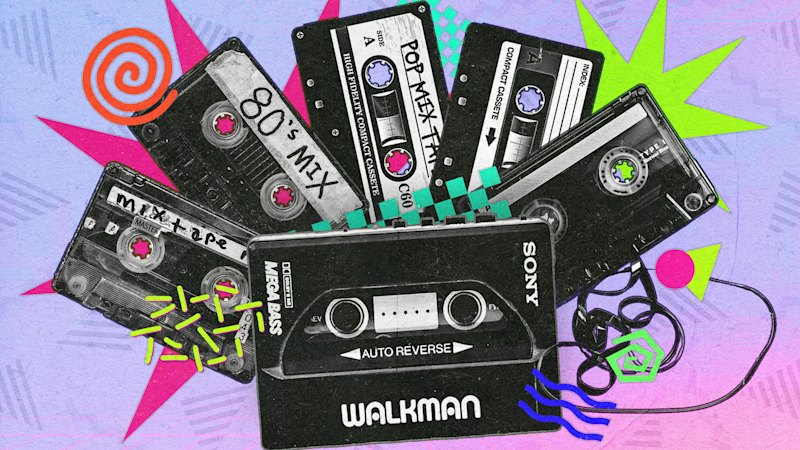
Blank cassette tapes were once used mainly by office workers for dictation. But in the 1970s, young music fans began using them to make copies of songs they loved, often by recording them off the radio.
Advertisement
Singer-songwriter Eleanor Friedberger, 49, who has a band with her brother, Matthew, called the Fiery Furnaces, recalled recording songs from the radio at age eight. “That was how it started, right?” she said. “Taping from the radio. I did that with friends, too. We’d kind of make our own radio shows.”
Jonathan Lethem, the novelist and essayist, remembered taping songs from the New York-area FM station WFMU when he was a kid. “You wanted to be able to hear that song when you wanted,” he said. “Some of us would tape a whole radio show.”
Lethem, 62, said he liked talking to younger people about cassette tapes because most of them were used to being able to use their phone and learn the name of a song or band almost instantaneously.
“But you have to imagine a space where music was a rumour,” he continued. “You might hear something and not be able to know what it was, and no one can tell you, and it’s driving you crazy.”
Advertisement
Music fans also used blank cassettes to record from full-length albums or singles. Those discs might be part of your own collection or someone else’s.
Home taping exploded in 1979, with the introduction of the Sony Walkman. At last, you could listen to what you wanted when you were on the move.
The music industry wasn’t pleased with this development and blamed it for a pronounced drop in the sales of vinyl records. The British Phonographic Institute, a trade association in London, mounted a campaign with a reproachful slogan: “Home taping is killing music. And it’s illegal.” In the United States, music executives pressed lawmakers to place a fee on blank cassettes and home-recording equipment.
None of it stopped youthful Generation Xers from turning themselves into amateur curators of sound. While this new pastime gave them the chance to hear their favourite songs in the order of their choosing, it served other purposes, too.
Advertisement
“I am what I play,” David Bowie sang on the 1979 song DJ, and the living-room DJs of the 1980s used the medium of the mixtape to forge their identities, flex their musical knowledge, telegraph messages and even flirt.
Forty years after I started making and exchanging mixtapes, I still remember which friend introduced me to which artist. These homemade cassettes had a way of casting an indelible imprint on our musical taste, fashion sense – even our worldview.
Lethem recalled a mixtape he heard in the 1980s. It was made by a friend of a friend who had juxtaposed songs in a way that seemed “counterintuitive, and then it became magic”, he said.
In particular, he recalled a segue from Work Song by Bill Laswell to Israelites by Desmond Dekker and the Aces. The person who put that cassette together “remained intimidating to me, because of the aura of the tape,” he said.
Mixtapes also served as stand-ins for DJs at parties. As Lethem put it: “I wanted 90 minutes of continuous danceable music, so people don’t sit down and wander away from the floor once the thing gets good.”
Advertisement
A Lost Art
The creation of a mixtape was a labor of love. It took time, thought and a level of physical co-ordination beyond what goes into the making of a Spotify playlist.
The two-sided cassette, which most frequently came in 60- and 90-minute iterations, offered opportunities to create two different vibes. Perhaps you wanted a moody Side A and an upbeat Side B, a dialectic you couldn’t create with the contiguous 80-minute CD-R mixes that came later.
One mix I still have comes from the fall of 1993. I was depressed when I made it, and I titled it Change My Mood. Perusing the track listing, I can detect frustration, anger and some ironic self-mockery.
Advertisement
Side A included Heart-Shaped Box by Nirvana, Avant Garde M.O.R. by Stereolab and Sheela-Na-Gig by PJ Harvey. Side B ended on a hopeful note, with Rebirth of Slick (Cool Like Dat) by Digable Planets.
The time limit of a cassette presented a challenge to the home taper. If you found yourself with under two minutes at the end of a given side, you had to find just the right song, one that would neither get cut off nor leave 30 seconds of dead space, which would ruin the flow.
John Cameron Mitchell, the actor, writer and singer, was another skilled maker of mixtapes. “You thought about the sequence beforehand, instead of throwing things at the wall,” Mitchell, 63, said. “It’s not unlike editing on film.”
He noted that mixtapes were often part of the courtship ritual.
“Once I was wooing a young lad who was into modern R&B but didn’t know anything about old R&B,” Mitchell said. “I’m a big Stax Records fan, so I made him a tape of old stuff.” With a laugh, he added, “I believe it came to fruition.”
Advertisement
Friedberger still has a mixtape given to her by a college crush. “It was better even than him asking me on a date,” she said. “The music on it was really influential for me, because it was like he was sharing information that I found to be incredibly valuable.” The artists included Donovan, the Moles and Brian Eno, she added.
Jay Smooth, 53, a hip-hop radio host and commentator, started making elaborate mixtapes as a teenager, when Run-DMC was at its peak and hip-hop artists were releasing 12-inch singles.
“For those of us who couldn’t afford to have two turntables, we figured out that if you press pause on the beat of one song and unpause right on the beat of the next song, you could have these seamless mixes where it sounds like you’re actually DJing with two turntables,” he said. “I was of the generation that put a lot of work into perfecting the ‘pause-button’ mixtape.”
Some mixtape makers would dub in their own voices. At 13, singer-songwriter Hamilton Leithauser was making a tape for a cousin who was going to sleep-away camp for the first time. “The first song was by Cypress Hill, and after the beginning of the song, I recorded myself rapping a verse as a joke, to catch him off guard,” Leithauser, 48, said. “When he listened to it with his new bunk mates, he was so embarrassed.”
Advertisement
No mixtape was complete without cover art – hand-drawn illustrations or collages decorating the cassette case’s paper insert. Along with the song titles and the artists’ names scrawled in tiny lettering, a distinctive title also helped. One mix I made was called Songs in the Key of Gay. Another, by my friend Christopher Schelling, was named Cha Cha Cocktail Bachelorette.
Sony stopped manufacturing Walkmans in 2010, but this year, Maxell released a portable cassette player with Bluetooth capabilities for nostalgists – and, presumably, to introduce cassette tapes to new generations of listeners who have demonstrated a love for vinyl. Leithauser, Friedberger and Taylor Swift are among the artists who have sold limited-edition cassette tapes at shows.
I’ve tried to play some of my old cassettes on vintage equipment. Sadly, the magnetic tape has worn down over time. So lately, I’ve tried to recreate my 1980s mixtapes on streaming platforms, using my handwritten track lists to guide me, only to find that quite a few of my old favourites have yet to make their way to the digital universe.
But the mixes I have managed to piece together have elicited intense memories, conjuring feelings and states of mind that I never expected to experience again. More than just relics, mixtapes are portals to specific moments. Perhaps even more than old photographs, they reanimate the past.
There’s one mixtape I haven’t been able to find. Would you believe it’s the one I refused to give up when I was mugged over 30 years ago?
Advertisement
This article originally appeared in The New York Times.
Must-see movies, interviews and all the latest from the world of film delivered to your inbox. Sign up for our Screening Room newsletter.
You have reached your maximum number of saved items.
Remove items from your saved list to add more.
More:
AdvertisementAdvertisement