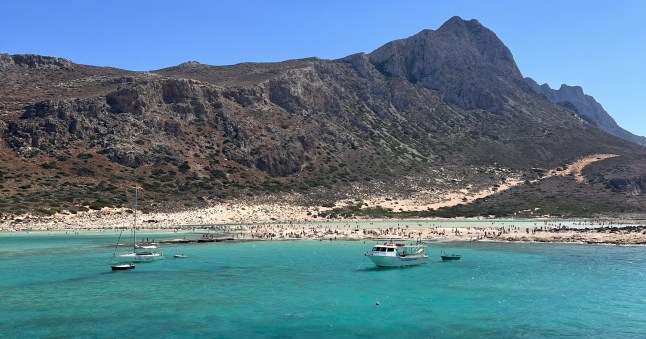
In September 2022 — almost four years to the day — I boarded a half-full boat from Kissamos Port in north-west Crete to Balos Lagoon.
This particular beach had been on my bucket list for some time.
I’d seen photos of shallow turquoise waters, pink-tinted sand, and dramatic cliffs, and heard stories about how it’s even better in real life.
It was. Pulling up to the rickety wooden harbour, everything looked HD.
Sheep calmly roamed across the sand. The ocean was a perfect temperature. The panoramic views from the mountains above were breathtaking.
But the thing I remember the most? For such a picturesque spot, it was remarkably quiet.
So, when I saw photos from the beach this summer, overrun by a mass of tourists, I was saddened.
It was not the Balos I recognised.
Chaos in Balos
Viral video footage showed people packed like sardines on said bridge, as more boats pulled in to drop visitors off.
The iconic spits of sand were just as busy, with tourists unable to lay down towels due to literal human gridlock.
Even looking at people’s faces, barely anyone was smiling.
Instead, many had their arms folded as they waited to be shuffled off to yet another natural wonder hounded by overtourism.
Watching the video, I asked myself: how in such a short space of time has this patch of paradise — now dubbed ‘hell on Earth’ — succumbed to such a bleak fate?
I also had to wonder — had I been part of the problem? If I was happy to spent a day there just four years ago, why should I expect the tourists of 2026 to be any different?
Local authorities estimate that the site receives around 2,000 to 5,000 visitors per day during peak season.
Midday is the busiest time, with large ferries arriving between 10:30 am and 11 am, adding 2,000 to 3,000 people to the lagoon within hours.
However, environmental assessments have calculated that the maximum safe daily capacity to protect Balos, which is a fragile Natura 2000 ecosystem, is roughly 2,230 to 2,330 people per day.
This means that peak summer days regularly surpass sustainable limits by over 50%.
Is there anything being done to limit the number of tourists?
Authorities are working on plans to limit numbers at Balos.
A pilot proposal submitted to Greece’s Ministry of Environment and Energy would introduce an online booking and reservation system with timed entry windows — much like what we’ve seen in Italy this year.
This plan would cap visitor numbers at 1,200 for a three-hour slot.
Once the time slot is over, tourists would be required to leave to make space for the next batch of visitors.
Should the booking system work, authorities hope to roll out the same idea at other ‘best beach’ hotspots like Elafonisi and Falassarna by 2027.
Overtourism in Greece
Like anywhere with natural beauty, incredible beaches, and good weather, Greece is paying the price for its own popularity.
Santorini, one of the most popular islands, has been struggling with overtourism for years.
Earlier this month, the village of Oia saw tourists form two-hour queues as early as 7 am, hoping to take photos of the iconic blue-domed churches.
Last year, Santorini and Mykonos introduced a €20 (£17) cruise tax, while both were also rocked by earthquakes.
Meanwhile, Zakynthos — also known as Zante — was dubbed ‘the capital of overtourism.’
Only around 40,000 people actually live on the island, but in 2023, a whopping six million people stayed overnight, mainly along its south coast.
Greece isn’t the only country capping its beaches
The latest onslaught of overtourism has left Italy no choice but to do something drastic.
It has rolled out booking systems for some of its most popular beaches.
From Sardinia to Lampedusa, the southernmost island, beaches are capping the number of people allowed to visit at a single time.
The hope is that this unprecedented move will help to tackle overcrowding and reduce pressure on the environment.
Some of the famous Italian beaches with booking systems include:
• La Pelosa — Sardinia
• Cala Brandinchi and Lu Impostu — Sardinia
• Cala Goloritzé — Sardinia
• Cala Violina Cala Goloritzé — Sardinia Tuscany
• Spiaggia dei Conigli — Lampedusa
• Baia del Silenzio — Italian Riviera
• Due Sorelle — Ancona (also known as Two Sisters Beach, this area is protected and only accessible by sea. Therefore, access to the beach and your ferry must be booked in advance.)
Comment now
Comments
Add Metro as a Preferred Source on Google
Add as preferred source