
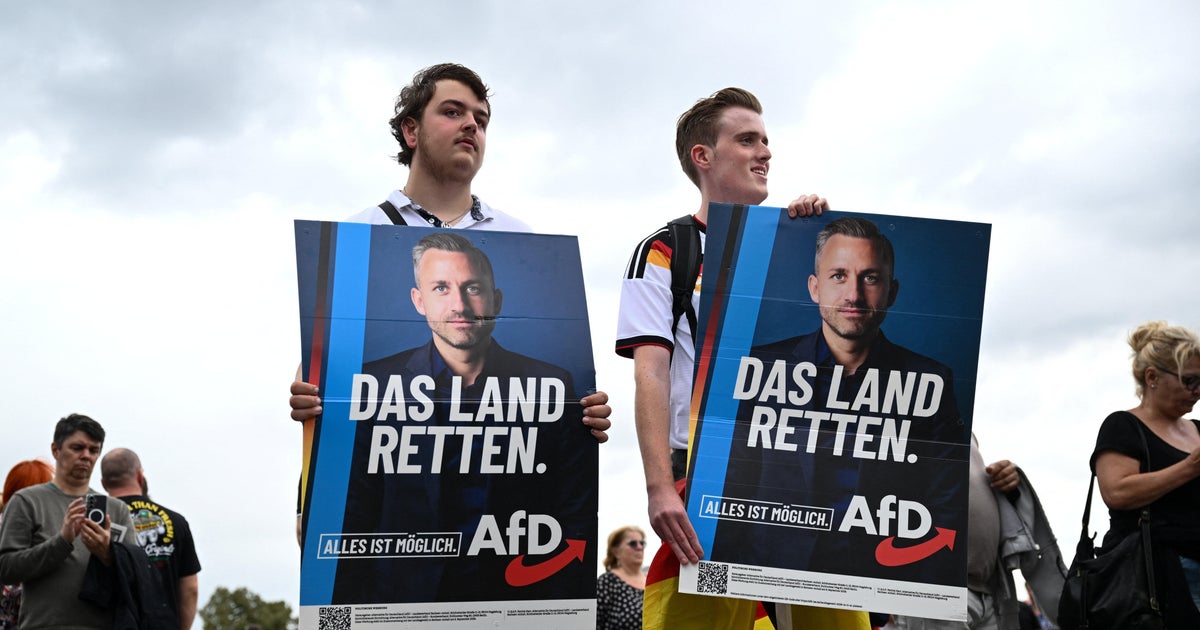
Magdeburg, Germany — At first glance, Magdeburg may seem an unlikely stage for a political upheaval of international significance. But this weekend, the city of only about 244,000 people will be at the center of an election that could leave a far-right party in control of a German state for the first time since World War II.
Magdeburg is the capital of the East German state of Saxony-Anhalt — where the Alternative for Germany (AfD) party is hoping to rise to power in Sunday’s state election.
Supporters and opponents of right-wing populist movements across Europe and beyond are watching closely to see if the AfD can turn a significant lead in opinion polls into real power.
The latest surveys show the AfD polling at 41%, well ahead of its closest rival, German Chancellor Friedrich Merz’s Christian Democratic Union (CDU), which stood Friday at 23%.
Should the AfD win, it would be an extraordinary breakthrough for a party founded in 2013 largely as a protest movement against the European Union, but which has since shifted far to the right.
What is the AfD?
Since 2023, the state Office for the Protection of the Constitution has classified the AfD Saxony-Anhalt as a “confirmed far-right extremist” organization.
According to the office, which is the state branch of Germany’s national domestic intelligence agency, the AfD chapter’s core positions violate fundamental principles of Germany’s constitution and are “substantially permeated by the racist ideology of ethnopluralism.”
“Numerous anti-Muslim, racist and antisemitic statements by officials and elected representatives of the state association demonstrate that the AfD in Saxony-Anhalt seeks precisely such an ethnoculturally homogeneous national population and calls for the exclusion of people on the basis of their origin or religion,” the agency says.
AfD Saxony-Anhalt’s main candidate in this election, 35-year-old Ulrich Siegmund, rejects the assessment. In an August interview, he accused the state intelligence agency of being politically weaponized against his party.
“It monitors the opposition,” he said. “It is being used as a political instrument.”
If his party wins power, it would consider either abolishing the state intelligence agency or restructuring it, he added.
Siegmund comes across as composed, charismatic and approachable. But the August cover of the widely-read Der Spiegel magazine branded him “Germany’s most dangerous man,” noting his combination of a winning demeanor, a realistic chance of gaining power of a state, and a radical platform.
The article noted that Siegmund’s close party associates include former officials from the “Heimattreuen Deutschen Jugend,” a neo-Nazi youth organization that was banned in 2009.
Siegmund was at the 2023 “Potsdam meeting,” a gathering of German and other far-right figures where Austrian anti-immigration extremist Martin Sellner presented his “master plan” for “remigration.”
The concept envisioned asylum seekers, non-Germans living legally in the country, and German nationals with immigrant backgrounds who had failed to “assimilate” in the country, all being expelled to live in an unspecified African nation. A version of the plan has become central to AfD Saxony-Anhalt’s platform.
The state party calls for a “deportation and remigration offensive,” with more detention centers to handle people destined for deportation, and advocating for new, tight limits on the number of people permitted to migrate to Germany. Currently there is no cap on the number of immigrants allowed into Germany every year, but the state AfD party has dismissed suggested caps of around 200,000 as far too high.
It may sound familiar to Americans, given the controversy over ICE detentions and the Trump administration’s aggressive deportation policies. But the concept of “remigration” is seen as a step further, given its association with the idea of expelling people living legally in a country, even passport holders.
AfD Saxony-Anhalt has also drawn criticism for the way it refers to Germany’s past.
Hans-Thomas Tillschneider, a leading state AfD politician, has spoken disparagingly of “memorial site stuff” and criticized a “guilt-laden” approach to German history. Such statements resonate in a country where memories of the repression and the orchestrated mass violence of Nazism and the Holocaust have shaped political discourse for at least three generations.
For the AfD, a complicated path to power
Just winning the most votes in Sunday’s election will not be enough to bring the AfD to power in Saxony-Anhalt.
The only guaranteed route to governing on its own and appointing the state’s next premier — the equivalent of a U.S. governor — is to win an absolute majority, taking more than half of the seats in the state parliament.
Polling made that look unlikely as of Friday.
If it wins a large number of seats, even more than any other party, but fails to make the threshold to govern alone, the AfD would have to find another party that also won at least 5% of the votes — and that is willing to partner up in a coalition government.
That could prove a very high hurdle. Germany’s other major parties have long ruled out any cooperation with the AfD.
Siegmund has said himself that he would only lead a full AfD government, ruling out any coalition.
So the party could win the election by a wide margin, but still end up wielding no real power in the state, and there is a recent precedent for that outcome.
The AfD won more seats than any other party in neighboring Thuringia last state election in 2024 — but not a decisive majority. Other parties with lower vote shares agreed to work together to form a coalition without the AfD, so while Thuringia has more lawmakers from the AfD than any other single party, they’re not part of the administration running the state.
What do the locals say?
Migration has been a dominant topic of debate on the streets of Magdeburg in the run up to the election, fueled by a 2024 attack on its Christmas market. A doctor originally from Saudi Arabia drove his vehicle into the revelers, killing five people.
He was not an Islamic extremist, and called himself a former Muslim. He was, in fact, critical of Islam and had expressed sympathy with the far-right and even the AfD. But despite that, and the fact that the perpetrator had been in the country legally for decades, the case still touched a nerve.
“I feel that the situation is particularly tense following the attack,” one woman, who declined to give her name, told CBS News this week in Magdeburg. “I think that has given the AfD a particular boost.”
Justin, 27, told CBS News that he supports the AfD and believes the party will take action against “uncontrolled migration.”
He said Syrians in particular, some 300,000 of whom were welcomed into Germany as refugees more than a decade ago during their country’s vicious civil war, have failed to adapt to life in the European nation.
“The AfD is good for Germany because they see Germany’s problems,” he said, adding that Syrians in Magdeburg “behave like animals.”
“I am sorry, but they sit on these plastic chairs with their children outside in the middle of the night and they are never quiet,” he said, admitting that, “there were Germans misbehaving” in Magdeburg, too, “but now it’s really bad. I think the AfD sees that and they will help Germans to also get more pension.”
His argument about Syrians is eroded by the fact that tens of thousands of have adapted to life in Germany — including one who came as a refugee in 2015 and has now been the mayor of a village in the country’s southwest for several years.
Another local voter, Birgit, sees the party very differently. She told CBS News she was “quite afraid of the AfD,” which she considers “far too extreme.”
A couple out on a date, who described themselves as left-wing former punk rockers in their 40s, told CBS News they were firmly opposed to the AfD and voiced consternation over the party’s stance on migrants.
They argued that foreign workers are and would continue to be indispensable to the health and social services, given Saxony-Anhalt’s aging population.
Another man said he had moved to Magdeburg from western Germany, and if the AfD does manage to take power, he said he couldn’t imagine staying.
As the father of a young girl, he said he was particularly concerned about how an AfD government might change the way Germany’s history, including its darkest chapter of Nazi rule and the Holocaust, is taught in schools.
In: