
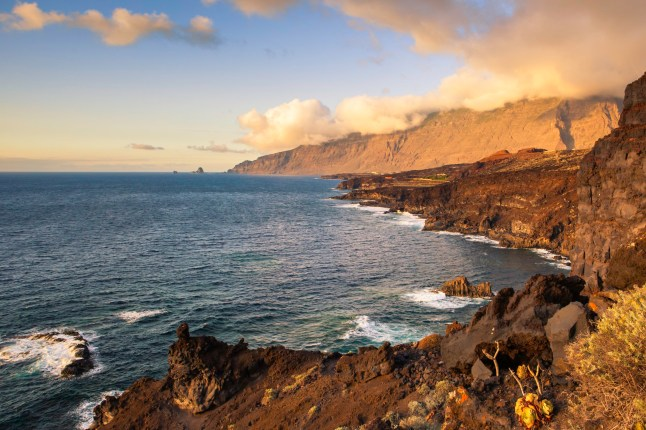
On the island of El Hierro, far from the crowds of Tenerife’s tourist strip, lies a secluded refuge with a rather unique booking system.
While most of us associate the Canary Islands with mass tourism, one remote resort is doing its best to sate the appetite of those seeking a more analogue approach to travel.
El Elevador is an austere and solitary accommodation perched on the edge of a volcanic cliff on the southernmost of the eight inhabited Canaries.
A simple, single-open space that sleeps just two guests, it’s a technological black hole — no phone service, no internet, and no nearby town to keep you entertained.
If that wasn’t intriguing enough, there’s more.
The most fascinating thing about El Elevador is that you won’t come across it on AirBnB or Booking.com.
The only way to visit the resort is by sending the owners a handwritten letter.
Almost like a verse from a Shakespearean sonnet, El Elevador’s website greets guests by stating: ‘Every journey begins with a desire. With an intention. With a letter.’
Captivating yes. But prospective visitors should be warned that this is no typical luxury stay.
There is no room service or state of the art interior. Instead, El Elevador encourages travellers to go back to basics. To enjoy the dramatic landscape and totally slow down.
Given its mystique, it might be unsurprising that prices have been omitted from the website. However, we wouldn’t expect it to be budget-friendly.
If your request is accepted, a letter containing a single digital link will be sent to you. Solely created for you to finalise dates and other details this will be your last brush with technology.
From there, your extreme digital detox begins.
For Dr. Elaine Kasket, a cyberpsychologist whose expertise lies in how we as individuals interact with technology, El Elevador’s brand and marketing strategy stands in stark opposition to the modern holiday-booking experience.
‘The usual process is quick and convenient,’ she tells Metro. ‘El Elevador is slow, requiring thoughtfulness, patience, and the constructive disruption of our the automatic, non-reflective, fast-paced behaviours we’ve fallen into with digital technologies.
‘To stay there, you have to stop, think, and reflect upon why you want to visit. Then you have to do something increasingly unfamiliar to many of us: you must sit down with pen and paper, formulate your plea, handwrite it, address an envelope, find a stamp. And THEN you must wait to see whether your bid is successful.
‘Unlike the online booking process, it’s odd, special, unfamiliar, and personal. It pulls a greater connection with our humanity from us, and it connects us with the human on the other side.’
In many ways, El Elevador’s entire business model feeds directly into growing trends we’re currently seeing across the wider travel industry.
Wellness tourism, for example, has become exceedingly popular over the past five years and is expected to be valued at $1.4 trillion by 2027.
Moreover, much like the slower, analogue lifestyle promoted at the remote resort, there is also evidence that travellers continue to value more traditional ways of experiencing the world.
While digital maps might still remain first-choice, a spokesperson from Ordnance Survey tells Metro that it ‘still sells close to a million copies of paper maps and books a year.’
Dr Andrew Stevenson, senior psychology lecturer at Manchester Metropolitan University and author of ‘The Psychology of Travel’, refers to this entire trend as a boom in ‘eudaimonic travel’.
‘The term basically means to “travel for self-improvement”,’ Andrew tells Metro. ‘Instead of looking for fun and sun, eudaimonic travel is a journey of self-discovery, finding out more about yourself and investing in restorative travel.
Another concept Andrew highlights is ‘psychogeography’ — the idea that our relationship with places is shaped by personal experience rather than a ‘predetermined itinerary.’
Many travellers still rely on algorithms to shape their journeys, whether that’s deciding which restaurants to visit or directing them towards a supposedly ‘hidden gem’ tucked away down a back alley, only to find it already has 100,000 likes on TikTok.
But Andrew describes psychogeography as a way of pushing back against this. “Places aren’t products that should be sold to everybody as a kind of mass tourism.”
El Elevador offers a unique experience built around this idea, an experience Andrew specifically calls ‘a direct backlash to TripAdvisor.’
More travel inspiration from Metro
- I found the best sunset spot in Ibiza that isn’t packed with tourists
- The enchanting Canary Islands that tourists rarely ever visit
- I’ve been to 23 Spanish cities, but there’s only one I keep going back to
- The 5 best September destinations in Spain, Greece and Portugal
- I discovered the ‘unmissable’ side of Tenerife I never knew existed
And, as Elaine notes, ‘much of the magic of travel involves the unexpected; the unpredictable; the uncontrollable; the magic serendipity.
‘Everyone has the right to decide what they expect from a break, of course, but the technologically, algorithmically driven world of travel and hospitality often caters to consumers, not travellers.’
So, the next time you go away, Andrew suggests you take the time to rethink how you go about experiencing a new location.
‘When you arrive somewhere, try to experience it through the senses. Don’t reach a decision straight away – internally giving it three or five stars.
‘And when people ask you about a place, don’t say “oh, it was great” or “it was rubbish” or even make comments such as “I’ve done Bali”. Instead describe things about the place, the things you saw – leave it up to others to decide whether it’s attractive to them or not,’ he explains.
In a lot of ways El Elevador is a special experience, yes. But it’s also a challenge.
The question is: could you last a week there?
This article was originally published on July 21, 2026.
Comment now
Comments
Add Metro as a Preferred Source on Google
Add as preferred source