
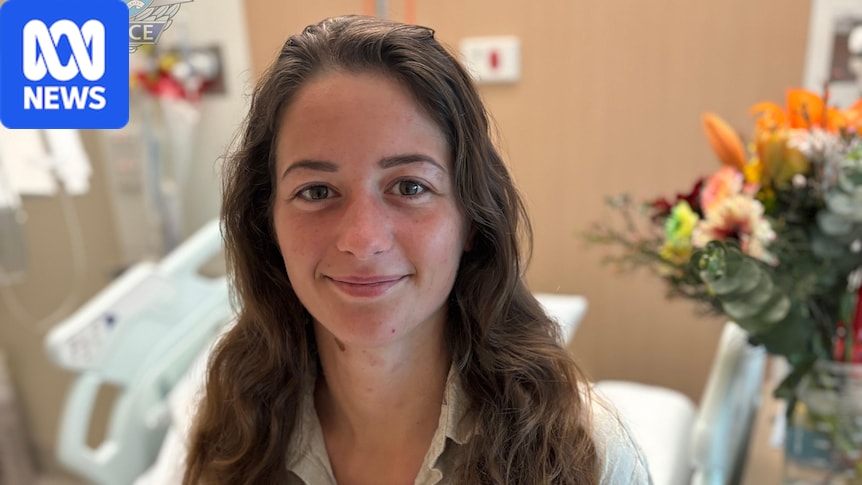
German backpacker Carolina Wilga reveals incredible Australian outback survival story
Posted Fri 4 Sep 2026 at 4:31pmFri 4 Sep 2026 at 4:31pmFri 4 Sep 2026 at 4:31pm, updated Fri 4 Sep 2026 at 4:43pmFri 4 Sep 2026 at 4:43pmFri 4 Sep 2026 at 4:43pm
In short:
Backpacker Carolina Wilga has released a book about her incredible survival after 11 freezing nights lost in WA’s remote Wheatbelt region.
Ms Wilga detailed how she crashed her van on an outback track and in a confused state had been trying to follow a sound that took her deeper into the bush.
She also revealed how she was found by local farmer Tania Henley, and the emotional embrace she shared with her rescuer.
Lost in Western Australia’s harsh outback, Carolina Wilga dragged herself on metre by metre, fearing she would die as she fought dizziness, a desperate thirst and the dry scrub relentlessly tearing at her body.
The German backpacker has now revealed how she survived 11 nights in freezing conditions, chewing on leaves, plant stems and flowers and sipping water from puddles before being found limping, sunburnt and barefoot by farmer Tania Henley on a remote road.
She has also explained how she crashed her van in a nature reserve, driving through a fence, smashing into a rock, and slamming her head against the side window.
Ms Wilga has just published a book of her extraordinary ordeal called ‘Escaping the Outback: My Fight for Survival in the Australian Wilderness’.
At the end of June last year, the then 26-year-old left Perth in her Mitsubishi van and went missing after last being seen at a general store in Beacon, 313 kilometres north-east of Perth.
Lured into the bush
Ms Wilga was driving through a rugged nature reserve 36 kilometres north of the remote town when the accident happened.
She initially only remembered fragments of the crash, but has now written that she swerved to avoid what she thought was an oncoming car.
The backpacker said she slept in her van that night and tried unsuccessfully to free the bogged vehicle.
She wrote that there was a sound that she could not explain which she began following deeper into the bush and away from her van.
Ms Wilga acknowledged it made no sense and sounded irrational, but it was what happened.
Loading…
She found herself wearing only a dress, a linen scarf and no shoes in the icy cold night, unable to remember what had happened to the boots, warm wool sweater and jeans she had been wearing.
As she stumbled through the bush, over tree branches and rocks, her head pounding, she realised in a panic that she was lost.
Condition deteriorates
Ms Wilga wrote how she pulled long green plants out of the soil to chew on, saying they tasted sweet, like lollies, but also dry and grassy with no water.
She found flowers but quickly spat them out again when they tasted bitter.
At one point, she also found the skull and bones of what she thought must have been a wild boar.
Desperately hungry, she said she sucked on a bone to get the marrow, but it tasted rotten and so disgusting she could not eat it.
She described the dust and sand sticking to her legs, scratches all over, ants crawling across her body and stings and itches.
Ms Wilga said she scratched herself bloody from sandfly bites and her tongue became swollen.
Family drove her on
Ms Wilga said she asked herself how bad it would be to die, unable to take it any more.
Soon after rain started falling and she lay on her back to let the drops fall in her mouth.
To stay sane and calm, Ms Wilga wrote she developed a mantra: that she should trust herself and she would be fine.
Knowing the sun set on the west coast in Western Australia, she followed it, and eventually she found a track which led her to a riverbed and puddles of water to drink from.
But Ms Wilga said what really gave her strength to keep going was the thought of her family waiting for her.
She pushed on, her feet badly swollen and cut, her mum urging her on in her head.
And then came the moment she said she knew she would survive — finding a cowpat, shards of glass and a rusty drinking can along a fence line she assumed lined a road.
Emotional rescue
When a car appeared in the distance, she said she stepped into the middle of the outback road and started waving her arms in the air.
It was local farmer Tania Henley, driving her car down the remote Mouroubra Road about 24 kilometres north-west of her stranded van.
Ms Wilga remembered seeing Ms Henley staring at her, her mouth hanging open.
Ms Henley knew who she was because of the massive search and rescue operation underway to find her.
She said they hugged tightly and Ms Henley told her she was safe.
Ms Wilga started sobbing, screaming and crying at the same time.
After her rescue, Ms Wilga said she experienced her first panic attacks about being lost in the bush, and said her biggest trauma had been the feeling of being stuck and unable to free herself from her predicament.
But she said she turned that into a strength, learning to trust and motivate herself, helping her keep going through hunger, thirst, cold, exhaustion and impenetrable landscapes to survive.
Editor’s note: Ms Wilga’s book is only available in German. The ABC used translation tools and verified the excerpts with a fluent German speaker.