
Advertisement
September 4, 2026 — 4:12pm
You have reached your maximum number of saved items.
Remove items from your saved list to add more.
The city’s newest airport has barely got off the ground, only to have problems at Sydney Airport bring it down to earth with a thump.
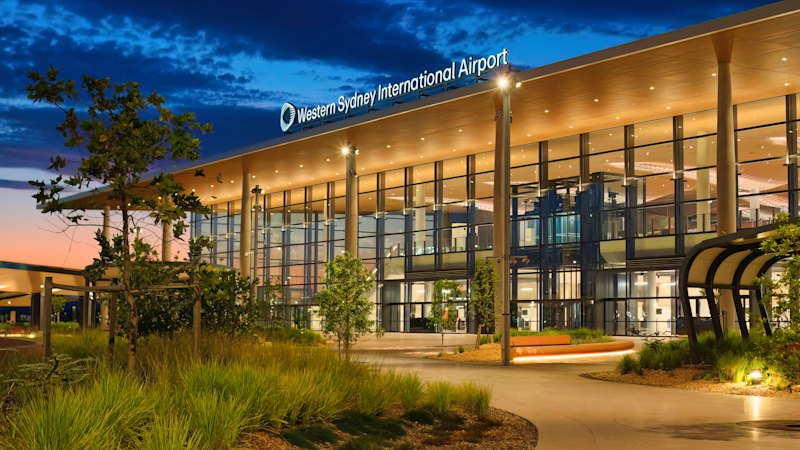
Western Sydney International Airport’s high-tech air traffic control centre is being kept shut for longer than expected, despite cargo flights operating and passenger flights starting in seven weeks.
The closures have been imposed to free staff to backfill rosters at Sydney’s Kingsford Smith Airport tower.
Staffing problems have been at the centre of an unprecedented number of potential systemic lapses at Sydney, with the Australian Transport Safety Bureau (ATSB) investigating six separate incidents that occurred within a month. They include a Qantas aircraft narrowly avoiding a runway collision and a Jetstar Airbus A320 being forced to brake when a Qatar Airways 777 was towed uncomfortably close. The ATSB’s preliminary findings on four incidents are due at month’s end.
Advertisement
An air traffic controller told the Herald’s Matt O’Sullivan and Chris Zappone that the control centre for Western Sydney Airport was now shut for more than half the week, leaving it operating for about 18 hours, from shortly after noon to early the next morning, on four consecutive days.
Any aircraft requiring an emergency landing would be unable to use the airport during the shutdowns because of the absence of air traffic control. “When all the incidents went very public at Sydney Airport with the tower staffing, they decided to claw back controllers to Sydney Airport, leaving the roster critically short at WSI. Typical rob-Peter-to-pay-Paul scenario,” he said.
The situation has been exacerbated by Western Sydney Airport grappling with technological challenges, with poor-quality digital images beamed from cameras on a tower next to the airport’s 3.7-kilometre runway to air traffic controllers 17 kilometres away at Eastern Creek. As a consequence, aircraft have been kept significantly further apart during landing for safety reasons.
The air traffic controllers’ union, Civil Air, played down the implications for the new airport of the lapse in staffing, and Airservices Australia, the government-owned organisation responsible for managing air traffic control operations, said it would “return to 24/7 coverage” of the new airport’s air traffic control before the start of passenger flights on October 25.
Airports are highly complex organisations and it is the task of government, regulators and unions to make sure they run smoothly, but it is understandable that there are public concerns after the recent spate of mishaps.
Advertisement
Airservices Australia has had capacity problems since the mass retirement of many controllers in 2021, when COVID shut down the aviation sector. Authorities have had years to prepare for Sydney’s second airport. It can take some 18 months to train an air traffic controller, and five years for staff to perform at high levels, yet we are none the wiser if enough are waiting in the wings.
Instead, the air traffic control problems that have plagued Sydney Airport are at risk of being repeated at Western Sydney International Airport, as authorities seemingly adopt a just-in-time strategy more appropriate to manufacturing than aviation. Passengers deserve better.
Jordan Baker sends a newsletter to subscribers each week. Sign up to receive her Note from the Editor.
You have reached your maximum number of saved items.
Remove items from your saved list to add more.
More:
The Herald’s View – Since the Herald was first published in 1831, the editorial team has believed it important to express a considered view on the issues of the day for readers, always putting the public interest first.AdvertisementAdvertisement