
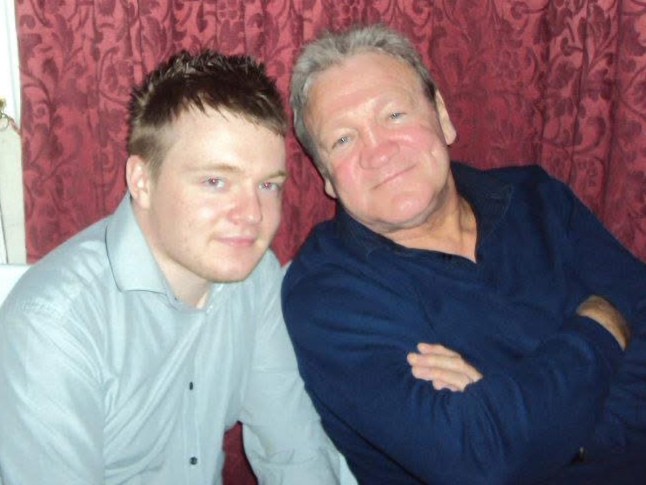
Everyone will have a different story about when that gnawing sense of dread began. For Michael Fethon, it was during the mundane act of tiling his kitchen over lockdown in 2020.
His dad Jim, a ‘typical Yorkshire person’, insisted he would do the work, telling him with classic paternal swagger: ‘You’re not paying somebody else to do it.’
But it wasn’t long before it became clear that something was wrong.
Michael told Metro: ‘When he came to doing the tiles, he said, “My head’s telling me I can’t do it.”
‘He’d say, “I don’t know what to do next,” when he was putting sort of the spaces in between tiles, or he’d forget to put some adhesive down, or forget a bit of grouting.’
Sign up for all of the latest stories
Start your day informed with Metro’s News Updates newsletter or get Breaking News alerts the moment it happens.
This was enough for him to bring up concerns with his mum Sheila, which she promptly brushed off. Then, Michael bought his parents afternoon tea at a posh hotel in Beverley, East Yorkshire, as a thank-you for the tiling help.
‘It was a place where they’ve been to numerous times in the past, had been there for years,’ he said.
‘[Jim] was panicking because he didn’t know how to get there, and he wanted me to go and sit outside and wait for him to have the afternoon tea, because he was frightened about getting there, frightened about getting lost.’
This time, Michael’s mum got a telephone appointment with the GP – but was told her husband’s behaviour was ‘probably just anxiety-driven because of the pandemic’.
It was the beginning of an agonising 18-month wait for the diagnosis that the family expected but feared: Jim had dementia.
Over that period, there were many more conversations with GPs following further troubling behaviour, and all the brain scans, memory tests, and other assessments that came as a result.
Michael said: ‘Seeing your dad deteriorate over time, with just little things like becoming more anxious to the point that even before he had his diagnosis, I went round one evening and he didn’t know who I was.
‘But there was no support, because we’d waited 18 months for a diagnosis.
‘It wasn’t like we had any support available to be like, this is what you expect at this part of the disease. We had no sort of guidance on what to expect.’
In the meantime, he ‘spent [his] life googling’ in an attempt to work out whether the changes he was seeing in his dad could be a result of dementia.
When the news arrived, it was in the form of a phone call, which explained that it was a life-limiting condition and offered to get Jim -then aged 69 – involved in clinical trials.
‘At that point, my dad was struggling to sort of comprehend the diagnosis we all were as a family, as much as we sort of semi-expected it,’ Michael said.
‘For them to just then jump in, “Oh, do you want to get involved in some clinical trials?” Just hang on a minute, we need to digest this information.’
Jim died at the end of May after several years living in a care home. He and Sheila would have marked their 49th wedding anniversary this year.
Even in the later stages of his dementia, his memory would return to the time he spent travelling the world in the Merchant Navy, Michael said – especially his visits to New Zealand, where he once considered emigrating with Sheila and their three sons.
Now, Michael is calling for a shift in the way dementia is handled by healthcare professionals, with referrals for assessment expedited like they are for cancer – meaning no other family would face a wait like his.
He said: ‘Looking at the statistics, dementia is the biggest killer in the UK.
‘So for me, I think if we know that’s the biggest killer in the UK, why is it not having the expedited referral for assessments as other illnesses do?’
After dealing with journeys an average of 20 miles to reach appointments, he also wants more assessments to be accessible in just one place.
Michelle Dyson, chief executive of the Alzheimer’s Society, said experiences like Michael’s are ‘sadly not rare’.
She said: ‘You would never accept someone being diagnosed with cancer left to work out the next steps on their own.
‘Yet that was the reality for Michael and his father Jim and is still the reality for too many people affected by dementia. This is simply not good enough. People affected by dementia deserve better.
‘At any time in the UK currently, around a third of people living with dementia do not have a formal diagnosis.
‘This is why Alzheimer’s Society is calling for every person affected by dementia to receive an accurate diagnosis and, crucially, a care plan and access to appropriate treatment, within 18 weeks of referral.’
She said the move ‘would bring dementia in line with all other major health conditions’, calling it ‘the very least that people with dementia and their families deserve’.
A spokesperson for the Department of Health and Social Care said: ‘Our sincerest condolences are with Michael and his loved ones.
‘This government is determined to strengthen the support that is available both to individuals affected by dementia, and the family members who look after them.’
They continued: ‘We are bringing forward the timetable for Baroness Casey’s commission on reform of the social care system, and we are appointing a new dementia tsar to help lead our work in that area, as recommended by Baroness Casey.
‘We are also implementing a new action plan for unpaid carers to ensure that they receive the support and recognition they deserve for the selfless work they do.’
Get in touch with our news team by emailing us at [email protected].
For more stories like this, check our news page.
Comment now
Comments
Add Metro as a Preferred Source on Google
Add as preferred source