
Advertisement
“Some photos are so close I can almost touch them,” says Andrew Chapman. “Others are cloudier than a bowl of vegetable soup.”
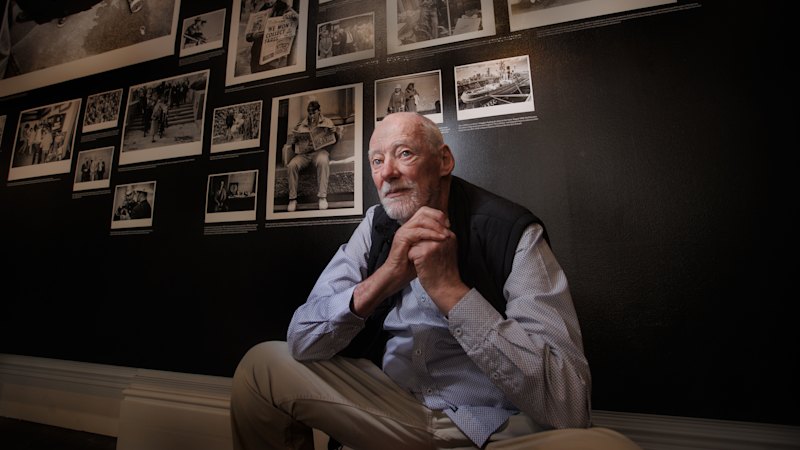
In City Gallery, at the front of the Melbourne Town Hall, Chapman has selected 55 of his photos to represent 55 years of his career as a photographer. It’s a rare glimpse into a Melbourne that no longer exists.
These photos, mostly in high-contrast black and white, capture Melbourne in its “big country town” phase. It’s sparsely populated and unpretentious, with a burgeoning diversity. Horses drag milk carts. Livestock is auctioned at saleyards. At a Vietnam War moratorium in 1971, suited businessmen share the frame uneasily with long-haired protesters.
“I find there’s a quietness in these photos,” he says. “A newspaper photographer wouldn’t shoot many of these, because there’s no editorial value. I would just take things because they were there.”
Advertisement
Their lack of “editorial value” is precisely why they stand out today – they’re a glimpse at unassuming daily lives lost to time.
There’s a bit of Henri Cartier-Bresson to Chapman’s eye and, closer to home, a bit of Rennie Ellis, and his contemporaries in the 1970s scene based around the Prahran Technical School, where he studied. As his career took off, Chapman worked as a photojournalist for the Melbourne Times, Business Review Weekly, The Bulletin, and Time. He’s travelled Australia photographing rural locales, won numerous awards, and been recognised with an OAM.
“I often talk about a good photograph being about synchronicity, where everyone’s just in the right place.”Photographer Andrew Chapman
But The Green Bus focuses on a roughly five-kilometre radius around Melbourne’s CBD. Vanished architecture brushes against flashes of familiarity. As we follow the decades clockwise around the room, the new world emerges from the old. A 1974 shot taken from the top of Park Towers, South Melbourne, finds skyscrapers climbing from the largely flat city.
The “Green Bus” of the title was the suburban bus service Chapman used to catch from Elsternwick to the city as a child in the 1960s.
Advertisement
“The green bus was my vehicle to independence, in a sense,” Chapman says. “We didn’t have a car or a television.” He recalls cooking classes at the Gas and Fuel Buildings and dipping into the museum to look at the vintage firearms. As he got older, he started bringing his dad’s camera into town, a 1930s Zeiss Ikon Nettar.
Many of these shots are kinetic with life. Smoke billows from a burning Ford Cortina outside a car dealership in Southbank, 1979. Children play outside a housing commission tower in Carlton. Three tired-looking pedestrians lean against South Melbourne Post Office, all gazing in different directions out of the frame. Some were taken on assignment from newspapers, and some were taken in spare moments wandering around the city. They appear candid one second, carefully composed the next.
The Age photographer sent to take Chapman’s portrait, Simon Schluter, can’t help but cut in and compliment the shots. Though we are inundated with street photography these days, Schluter says compositions like this are a lost art. “It’s a really important document,” he says. “The ability to shoot these without being noticed, just blending in, dissolving into the scene, is a huge skill.”
“I often talk about a good photograph being about synchronicity, where everyone’s just in the right place,” says Chapman. “That’s what makes the photo work. I reckon you can remove just any one person from these, it kind of falls over.”
Advertisement
Chapman has been able to identify many subjects over the years, but not all. Some, like an Anzac veteran in the back of his car, he wishes he’d asked at the time. Chapman hopes some may discover themselves in this show.
One he remembers vividly is Alec Pearse, co-owner of Hudson’s Stores, the ragged old hardware store that stood on Bourke Street for decades. He remembers the conversation with Pearse inside the store, the moment the shutter clicked.
“I was pretty naive and young,” says Chapman. “For some reason I took it on an eight-second exposure. I made him stand there, rock-solid still, for eight seconds. What was I thinking?”
In later years, colour creeps into the shots. Chapman traded the green bus for hot air balloons, and a 2014 aerial shot captures the city at the tangle of skyscrapers we know today.
Advertisement
“Have a look at this guy up here.” Chapman’s pointing not at one of his photographs, but at a man across the street I’d never have noticed, leaning out a window three storeys above the Capitol Theatre, shirtless, drinking a coffee in the sun. The street is quiet for mid-morning, just a handful of pedestrians. It’s the first day of spring.
“He doesn’t know he’s being looked at,” says Chapman. “I think he’s got it sorted. There’s that beautiful light that Melbourne produces too. In Melbourne on a blue-sky day, everything just sings.
“It’s a beautiful city. Always has been.”
The Green Bus is at the City Gallery, Melbourne Town Hall, until February 19.
You have reached your maximum number of saved items.
Remove items from your saved list to add more.
More:
Will Cox writes fiction and arts criticism. He’s based in Merri-bek.AdvertisementAdvertisement